
LAUDED?Steep poet Edward Thomas is acknowledged as one of the greatest writers of the English countryside, his verse grounded in a pastoral patriotism that makes him unique among the poets of the First World War.
Born in Lambeth in London in 1878, the eldest of six sons to Welsh parents, Philip Edward Thomas was educated at several schools, including Battersea Grammar School and St Paul’s School in London. His father, who worked as a civil servant, urged his son to study for the civil service examination after leaving St Paul’s in 1895. Though he acquiesced and prepared for the exam, Thomas retained his desire to write and began publishing essays instead of pursuing a career in the civil service. Encouraged by critic James Ashcroft Noble, Thomas compiled and published his first book, The Woodland Life, in 1896, a collection of essays about his long walks.
The Thomases moved five times in a 10-year span. Most notably, in 1906, they moved to Petersfield, and later to the nearby Yew Tree Cottage in Steep, where the countryside had an immediate influence on Thomas’s poetic landscapes.
In September of 1916, Thomas began training as an officer cadet with the Royal Garrison Artillery, and by November he was commissioned second lieutenant. He volunteered for service overseas and was sent to northern France, where he was stationed at Le Havre, Mondicourt, Dainville and, finally, at Arras. On the first day of the battle at Arras, on April 9, 1917, Thomas was killed by a shell blast.



It was Easter Monday, and the first edition of his poems was being prepared for press.
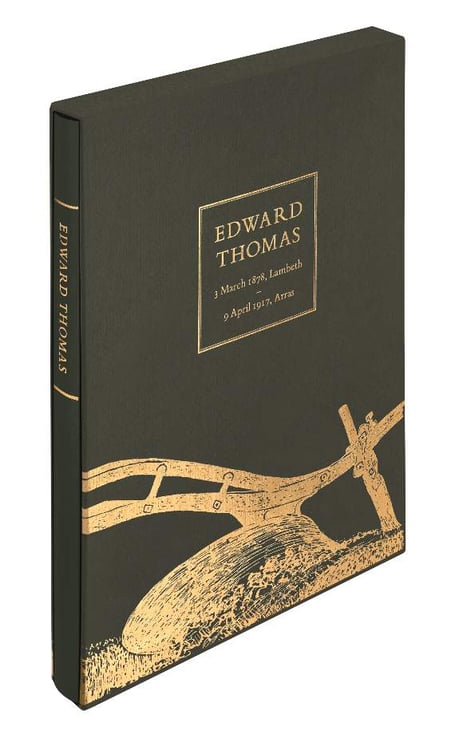
To commemorate the centenary of his death, The Folio Society has published an exquisite edition of Edward Thomas: Selected Poems. Limited to 1,250 copies, the book has been set with original lithographs by artist David Gentleman, who has signed each one.
Like his Victorian and Georgian counterparts, Thomas was a celebrant of the profound beauty to be found in the natural world, but his faith in the plain rhythms of speech and his intensity of vision mark him out as an influential precursor of WH Auden and Ted Hughes, who referred to him as “the father of us all”.
One of Britain’s most important poets, Thomas represents, as former Poet Laureate Andrew Motion astutely observes in his introduction to this volume, “a kind of hinge, connecting British poetry with its tradition while swinging it forward to feed our own time”. Motion has nominated ‘Old Man’, included in this selection, as his favourite poem.
For more details or to buy the book, visit foliosociety.com.
Comments
This article has no comments yet. Be the first to leave a comment.