
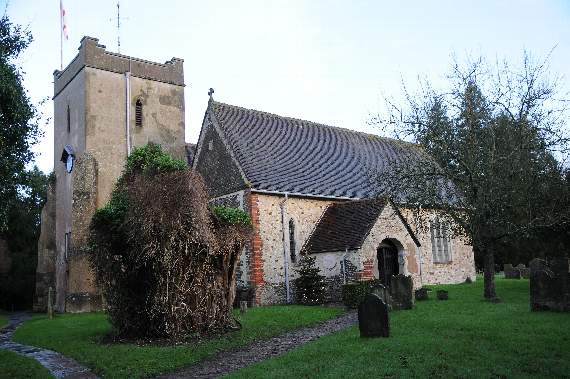
IT has been a long three-year fight to get enough money to save the crumbling structure of St Mary’s Church in Selborne.
But this week the Parochial Church Council heard it had been given the final £66,000 grant from the Heritage Lottery it had been waiting for.
This means work will start in the spring to restore the 800-year-old Saxon building and there is even enough money to improve access to the bell tower, which had become a little crowded after two more bells were added to the original six.
The fundraising to save St Mary’s began in 2012 when an Auction of Promises was held to set the fund ball rolling and alert parishioners to the urgent need to repair the church because cracks were beginning to appear in the stonework of the Grade I Listed building and some of its tiles had fallen off.

Early in 2013 the first steps were taken by the Parochial Church Council to get a Heritage Lottery grant because £100,000 was needed to do the work.
Council chairman Richard Irwin, assisted by his wife Dr Rosemary Irwin, took charge of the paperwork to submit an application for Lottery funding, resulting in £16,000 from the Heritage Lottery after agreeing to match the amount.
At the time Mr Irwin told the Herald: “We owed the success of the first part to the support and help we had from former Parochial Church Council member, Stewart Tate, and Robert Updegraff, who is in charge of future the church maintenance and heating.
“Also, we owe a huge vote of thanks to those who organised and supported our Auction of Promises, which helped to raise some of the money we needed.”
Some of the £16,000 went towards funding the development work - how they were going to do the repairs – and this was then followed by a long wait to hear if they would get the rest of the grant, which it was hoped would be around £100,000.
The Church Council got permission to go ahead with the development work, which included having to produce surveys on the bat population and the structure of the building; looking at alterations to the entrance of the tower; putting out tenders for the work, and confirming the appointment of architect Simon Cox.
While this long pre-planning process was going on, the Church Council became aware of the increasing number of cracks in the stonework of St Mary’s and spent £15,000 carrying out repairs, but it was obvious much more had to be done.
Giving an assurance that the church was not in danger of falling down, Mr Irwin explained the need for the repairs: “It is because it is a Grade I Listed building and, as such, we have to make sure it is preserved.
“We are simply carrying out good housekeeping in looking after the church and this is very much a community project.”
Mr Irwin said: “We have just heard that we have got the second grant of £66,000, from Heritage Lottery and with the money we have raised, and we raised a lot ourselves, we have the £100,000 needed to start to repair the church.
“Also, we have had a bit of a bonus. When English Heritage became involved it carried out an inspection of the building and went up into the bell tower where it found getting in and out was difficult, so we will use some of the £66,000 to improve the access.
“The tower became more difficult to access after we added two more bells 10 years ago to the original six.
“The bell ringers themselves raised the money to buy the new bells and we went back to the same foundry in Whitechapel in London (founded in 1570) to get them.
“As the last of the other bells was hung in 1700 we were amused when the foundry said it had wondered when we would be placing another order.”
St Mary’s is one of the loveliest churches in Hampshire and its historical roots stretch back to Saxon times, its Norman tower dates from 1180 and the font is 800 years old.
Some of its details are recorded in the Domesday Book, in which the village is referred to as Selesburne.
This peaceful little church has had a colourful history. It saw desperate times during the Swing Riots of 1830 when the workhouse was damaged and the resident vicar of the time, the Rev William Cobbold, was threatened with violence because he would not reduce the £300 tithes he demanded from villagers each year.
He was advised by some farmers, who were anxiously watching the proceedings and had been induced to increase wages, to accept a reduction or he would be “murdered and his house pulled down”, such was the strength of feeling among the villagers.
The vicar rapidly acquired a huge dog for self defence and its large leather studded collar is still kept at the church.
According to historian John Owen Smith, and referring to the Selborne and Headley workhouse riots of 1830: “If the tithes could be reduced, then the farmers could, in theory at least, pay the difference in higher wages to their labourers, and perhaps even take on more labour than before.
“This would stop the need for payment of parish relief to these labourers and their families, which would then reduce the Poor Rate payments of all taxpayers in the parish.
“In short, everyone would seem to gain from it except the clergy, and possibly the master of the poor house who would be given less money to dispense. The main target of the villagers was therefore the church tithes, which were seen as an unnecessary drain on parish resources, and in Selborne, at least, as going into the pocket of an unpopular man.”
The Trumpeter, John Newland, “a big strong man” who had served in the North Hampshire Regiment, was said to have rallied the rioters by blowing his horn and escaping arrest by hiding in the woods and only coming out at night for food. He was finally arrested and one of the names on the warrant was E Knight Jnr, Jane Austen’s nephew.
The Trumpeter is buried near the remains of the 1,400-year-old yew tree in the churchyard at Selborne which was sadly blown down in the hurricane of 1990. Ancient human remains were found among the tree’s great roots which were re-interred at a special service conducted by the Rev James Anderson. The Selborne yew is recognised as one of the 50 great British trees and a cutting survives in the churchyard.
The great nephew of the famous naturalist Gilbert White instituted much restoration work on the fabric of the church in the mid 19th century. Gilbert White had been curate for many years until his death in 1793 and is buried in the churchyard.
He is commemorated by a stained-glass window showing St Francis surrounded by his beloved birds and animals.
The church has not escaped the scourges of modern times. There have been some thefts from the interior in the past and, more recently, lead has been stolen from the church roof.
The subsequent ingress of water caused damage to large areas of the stonework.
Comments
This article has no comments yet. Be the first to leave a comment.