
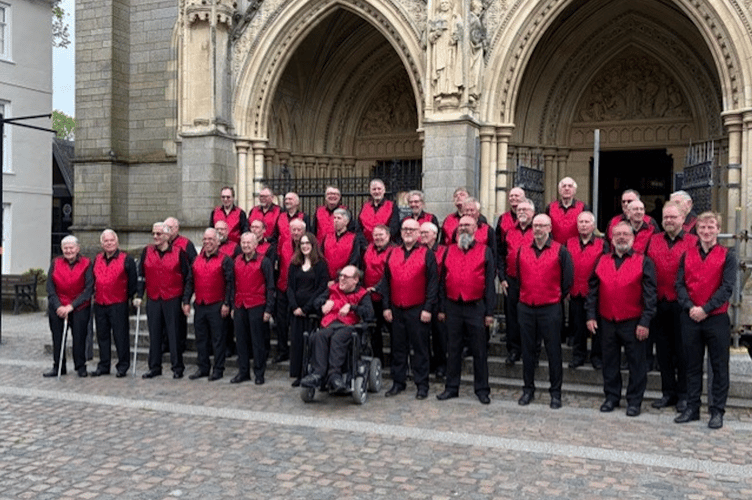
Hampshire and Surrey Hills Men’s Choir
The Hampshire and Surrey Hills Men’s Choir won the silver medal at the Cornwall International Male Choral Festival.
It came second out of ten choirs in a competition held in Truro Cathedral.
The choir’s four competition pieces showcased its remarkable breadth and musical accomplishment.

It began with Pueri Hebraeorum by Giovanni Pierluigi da Palestrina, a challenging polyphonic Renaissance work.
Next came The Willow Tree, a traditional Hampshire folk song specially arranged for the choir by local musician Simon Hancock in memory of long-term choir member Brian Carter.
This was followed by Smoke Gets In Your Eyes, a beloved male voice choir standard by Jerome Kern.
The choir concluded with Soon Ah Will Be Done, a deeply moving African-American spiritual in an arrangement by William Dawson, a pioneering musician who became the first African-American to receive a Doctor of Music degree.
Choir chairman Mark Kusionowicz said: “We are absolutely thrilled with the award, which is testament to the hard work put in by every choir member to reach this standard, our talented music director Philip Viveash-Brainch, and accompanist Charlotte Hobbs.”
The choir also gave public performances in Bodmin, Porthleven and Falmouth, including a concert inside the keep of Pendennis Castle.
During the festival, which ran from May 1 to 3, a total 25 public concerts were performed at 23 locations across Cornwall, from St Just in the far west to Saltash in the east.
The choir is giving a concert in aid of the Mayor of Rushmoor’s charitable trust, Step Beyond Alderwood, on May 16, and a summer concert at St Thomas-on-The Bourne Church in Farnham on July 18.
It is also holding an open evening rehearsal for prospective new members at North Camp Methodist Church on June 1.
There are no auditions to join the choir, which features men from across Hampshire, Surrey and Berkshire.
It performs concerts featuring its own semi-chorus and soloists, and often includes guest performers sharing the stage. The repertoire includes traditional male-voice pieces, folk songs, show tunes and popular song arrangements. Each concert raises funds for local charities.
For more information visit www.hampshireandsurreyhillsmenschoir.org.uk
Dementia-Friendly Alton
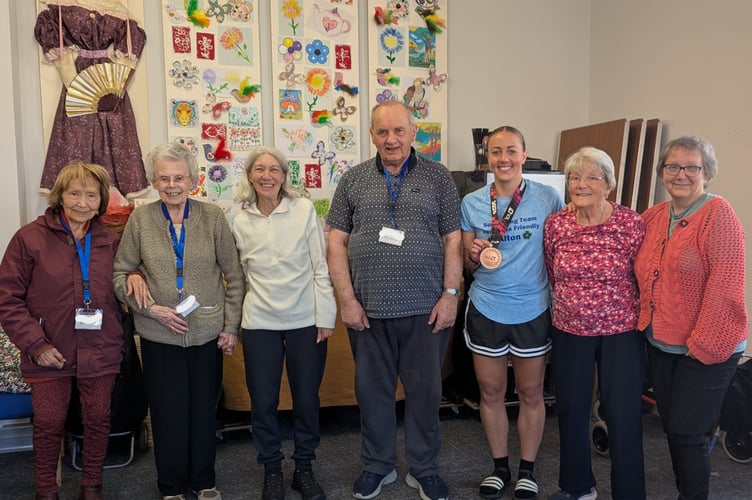
Charlotte Timms, pictured with her medal, ran the London Marathon to support Dementia-Friendly Alton - as her nan is one of the members - and raised more than £2,500.
Farnham Lions Club
Farnham Lions Heartstart courses will give people the skills and confidence to act if somebody has a cardiac arrest.
They will be held upstairs at The Ball and Wicket pub in Farnham Road, Holt Pound, on May 27, June 10, June 24 and July 8 from 7pm until 9.30pm. There is free parking in the pub car park.
Courses are free but donations are welcome. For more information visit www.heartstartfarnhamlions.co.uk, email [email protected] or call Jo on 07793 273941.
Sheet Film Club
Sheet Film Club is showing I’m Still Here at Sheet Village Hall on May 21 at 7.30pm.
Directed by Walter Salles, this 2024 movie is set in Brazil, where a military dictatorship lasted from 1964 to 1985.
In 1971, in Rio de Janeiro, former congressman Rubens Paiva - a family man and engineer, who lives with his wife Eunice Paiva and their five children - was abducted.
His wife Eunice was also taken, with a hood over her head, and kept in an unknown place for three days listening to people being tortured around her.
She returned home, moved with her family to São Paulo and never saw her husband again. To this day his body has never been found.
The film is based on real events and charts the experience of individuals who refused to accept violent repression and denial of their human rights during those two decades. This moving political testimony won multiple international awards.
All are welcome, whether members or not, and admission costs £6 on the door. The bar opens at 7pm and snacks can be ordered at the door from The Queen’s Head for the interval. Tickets can be bought in advance at https://webcollect.org.uk/sheetfilms
The Woodlarks Centre
The Woodlarks Centre residents and the 1st Rowledge Rainbows and Guides are holding a Sausage Sizzle at the centre in Lodge Hill Road, Lower Bourne, Farnham, on May 20 at 5pm.
The leaders of the Guides and Rainbows will work closely with residents to produce some seasonal hanging baskets to beautify the patio, which is much loved and well used, while concurrently barbecuing some sausages for everyone to enjoy after the production of the baskets.
The Woodlarks Centre’s project manager Karen Sarkissian said: “This is a unique community initiative which will highlight the value of the work of the Rainbows and Guides and bring together people from ages four to 80.”
The Carers Circle
A new monthly group for carers called The Carers Circle will meet for the first time at Hartford Care’s Alton Place care home in Winchester Road, Alton, on May 18 from 2.30pm to 4pm.
It is for carers in need of a well-earned break and a chance to connect with others while sharing experiences and support.
They can enjoy coffee, cake and good company in the home’s café while loved ones take part in engaging activities with residents and staff.
For more information or to book a place call Lucy Vaughan on 07860 682176 or email [email protected]
The Arts Society Alton
The talk at The Arts Society Alton’s meeting on April 14 was presented by artist and lecturer Richard Whincop and called In the National Interest: Art, The Sun King and the Academic Revolution.
It was essentially about the power of propaganda and choices to present a country in a new light and steal market leader status from a rival.
Academies formalised education in Renaissance Italy and at the beginning of the 17th century northern Italy was the pinnacle of artistic achievement. All serious artists trained there under the Guild of St Luke.
The structure applied to the arts elevated the artist to professional status and prized geometry, clarity and morality highly, but with strict Guild controls and accompanying exclusivity.
The Guild believed geometry was the crux of all art. Richard showed members, using Raphael’s The School of Athens painting, all the qualifying skills incorporated, from compasses to life drawing decorating the Philosophers.
He then showed Nicholas Poussin’s The Rape of the Sabine Women and explained the geometry and grid structure in that picture.
Poussin, a Frenchman, took his training and ideas back to Paris where Louis XIV, encouraged by Cardinal Mazarin, wanted to make Paris the artistic centre of the world and France the most significant power.
Portraits of Louis represented him as a hero, warrior and philosopher to burnish his reputation, and the place of France in the world. It was a project to make Louis into the Sun King and merge his image with the state.
Louis appointed classically trained artist Charles Le Brun to set up royal academies of painting and sculpture in 1648, followed by academies of science, inscription and medals, and music, based in the Louvre.
The Louvre was an academic building with no public access, slightly like an Oxbridge college. There was kudos and tenure associated with being an academician and membership was highly sought after.
Civil unrest in Paris gave Louis the opportunity to move the court out of the city. Italian architect Bernini was invited to plan a new palace but Frenchman Charles Perrault actually designed the Palace of Versailles after presenting drawings in a more opulent and grander way.
At the height of construction 36,000 craftsmen worked there. Nothing was too much - the best mirrors, fountains and murals. The Gobelins tapestry factory made glorious wall hangings presenting great royal moments for furnishings and as state gifts.
Charles Le Brun called it “the greatest art of all time”, with the Sun King always at the centre. It was not very subtle state propaganda.
Le Brun was seen as inflexible, which set his academies on a collision course with those not admitted who objected to state sponsored art being the only art considered. Tight rules of artistic achievement through classical training were challenged from outside.
Change was forced by the French Revolution. The Louvre became a public building and the academies were closed, only to reopen as the Ecole Des Beaux Arts under Napoleon but with traditional rules and drawing methods relaxed.
Lighter, freer, more socially current pictures became accepted, leading to new schools of art such as Romanticism, Realism and Impressionism. Arguments between classicists and colourists continued but the walls began to reflect the change.
The classical monopoly was overturned and academies were set up all over Europe.
London opened its Royal Academy in 1768. To this day there can be no more than 100 members, all practising professional artists working in the UK. There must always be at least 14 sculptors, 12 architects and eight printmakers; the rest are all painters.
For more information on The Arts Society Alton visit www.tasalton.com
Comments
This article has no comments yet. Be the first to leave a comment.