
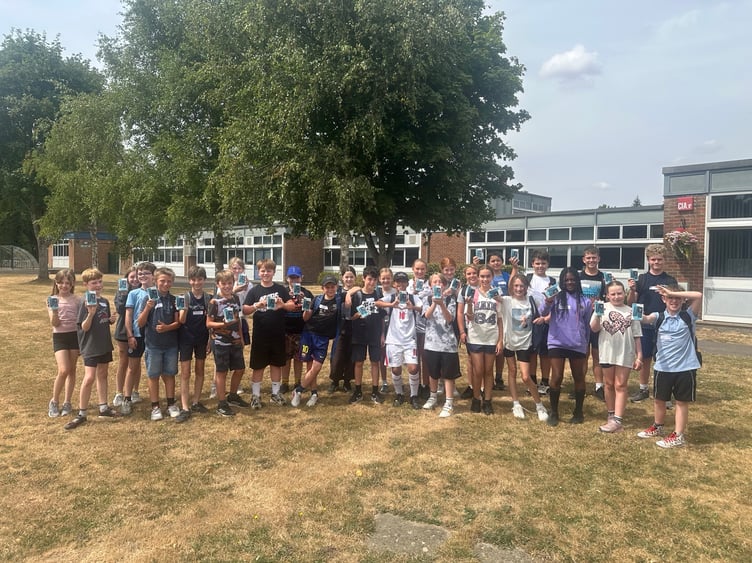
Forty Nokia brick phones have been given away to pupils starting Year 7 at Eggar’s School in Alton in September.
Year 7 is often the time when children are first given a mobile phone, as they begin travelling independently to secondary school over longer distances.
Parents want their children to be able to keep in touch with them but without encountering the distractions and dangers of smartphones with cameras and unlimited internet access.
The phone giveaway took place during a summer camp held to welcome the school’s new intake of children.
Erin Wills, soon to become the parent of an Eggar's pupil, said: “As a parent of a child starting Year 7 this September, I really welcome this. It takes away the pressure to have a smartphone and supports children to focus on friendships and settling in.”
The 40 brick phones were paid for by a £500 grant from Holybourne district and town councillor Graham Hill via East Hampshire District Council's Councillor Community Grant Scheme.
Matthew Hardman, the head of lower school at Eggar’s, said: "Eggar's School is incredibly grateful for this grant, which will allow us to provide a number of brick phones to our new Year 7 students through our summer camp programme.
“This support helps further our vision of being a school free from the distraction of smartphones during the day, and we hope it encourages more families to choose brick phones over smartphones."
In Hampshire, 180 primaries and 20 secondaries have introduced brick phone policies, some for the whole school and others starting with their new Year 7 intake and phasing out smartphones as the older children move through and out of the school. Eggar's currently retains pupils’ phones during the school day.
Roz Abery, of Alton Smartphone Free Childhood, said: "Brick phones that just call and text help children focus on making in real life plans and voice conversation, supporting well-being. For parents, bricks are much simpler and cheaper to manage than smartphones.”



In addition to local groups such as Alton Smartphone Free Childhood, there are also larger organisations campaigning on this issue.
Dr Susie Davies is chief executive of Papaya - Parents Against Phone Addiction in Young Adolescents - a nationwide charity providing talks and workshops to help parents and children make better choices about smartphones, social media and screen use.
Papaya presenters will lead two online talks for Eggar's parents this autumn - The Healthy Selfie and AI, Attention and Algorithms - which will also be held for Farnham secondary schools via a Farnham Town Council community grant.
Dr Davies said: “We are delighted that the grant application to fund a bulk purchase of brick phones has been approved.
“This initiative will help more families access simple, non-smartphones that enable children to stay in touch with parents and friends without the distractions and risks associated with smartphones and social media.
“By providing a safer alternative, brick phones support the aims of the upcoming social media policy and help promote healthier childhoods, while ensuring young people can still communicate when they need to.”
Cllr Graham Hill said: "I am delighted to have been able to devote £500 of my Councillor Community Grant fund to this excellent scheme.
“Excessive screen use is a growing issue among young people, and it is especially important that young children don't have the distraction of smartphones while they are at school.
“Using phones like these, that can only make calls and send texts, means that parents can reach their kids if they need to but still have control over their screen time and internet access.
“Every councillor at East Hampshire District Council is allocated £7,500 to spend on fantastic local schemes like this that really improve the lives of people in our local community."
The ‘brick’ description relates both to the size of early mobile phones and the technology available on them.
The first hand-held mobile phone was made by Motorola in 1973. It was cuboid in shape and weighed 4.4lbs - the same as a standard house brick - and the nickname was born.
‘Brick’ later took on a second meaning to describe a mobile phone with limited features - generally seen as having the ability to make and receive calls and texts, but without a camera or internet access.
The first mobile phone network was launched in 1979, and the first mobile available for sale - the DynaTAC 8000x - arrived in 1983.
Finnish company Radiolinja offered the first texting service in 1994, and Finland’s Nokia 9000 Communicator provided internet access for the first time in 1996.
The first mobile with a camera, the Kyocera Visual Phone VP-210, appeared in 1999, the same year users could text across all networks. Phones had also become tiny, and so the ‘brick’ era ended - until now.
In Hampshire, more than 8,000 parents have signed the Smartphone Free Childhood parent pact - a collective agreement to delay giving children smartphones until at least the age of 14.
The pact aims to dissolve smartphone peer pressure as parents and children see growing numbers supporting a new norm of simple phones for children.
Roz Abery added: “We're really excited about this promotion, helping to establish a new norm of starting secondary school with a simple phone. Huge thanks to everyone involved."
Comments
This article has no comments yet. Be the first to leave a comment.