
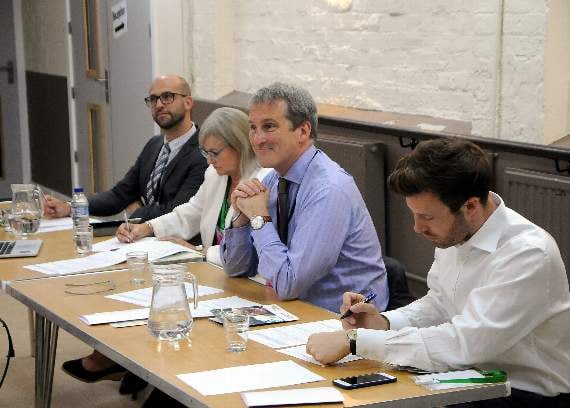
“YOU can’t have great schools without great teachers” – that was the very clear message from Secretary of State for Education, the Damian Hinds MP, after a visit to the East Hampshire constituency he represents.
Having secured the job he had told party members he would most like to do in government, the night he was adopted as a Tory candidate in 2010, and – having successfully fought three elections – Damian Hinds is flying high for East Hampshire.
Having served time as Exchequer Secretary to the Treasury in 2015 and Minister of State for Employment, in the Department for Work and Pensions (DWP) in 2016/17, Mr Hinds landed his dream job as Minister for Education during Mrs May’s January re-shuffle, inheriting the job from Justine Greening.
Married to a teacher, and with three young children, Mr Hinds would appear to have the right credentials for the job.




Shortly after entering Parliament, he was elected to the Education Select Committee, having previously chaired the All-Party Parliamentary Group on Social Mobility which, in its report, argued that the most important controllable factor in social mobility was the quality of teaching.
Six months into his new role as head of the Department of Education, Mr Hinds believes he is making progress.
Surprised but delighted when he was propelled into the driving seat, he had to get up to speed very quickly - his first Cabinet meeting was at 9.30am the following morning.
One of the aspects of the job is having to visit schools, kids and the country’s 450,000 teachers – all “dedicated and hard working”, as well as nurseries, colleges, and children’s social workers which, for Mr Hinds “is the best job ever as it’s all about people”.
Responsible for child protection, education (compulsory, further and higher), apprenticeships and wider skills in England, Mr Hinds’ main focus has been on teaching standards, building relationships, and making judgements about how best to help and support those in the teaching profession, with staff retention one of his top priorities.
Concerned over the workload and long hours which he believes is responsible for teachers quitting the job, Mr Hinds has been working with the profession, the unions and Ofsted to try to bring the workload down.
And, as news broke on Tuesday that one million public sector workers are to receive their biggest pay rise in nearly 10 years, with teachers getting up to 3.5 per cent worth between £800 and £1,366 per year for classroom teachers on the main pay range, Mr Hinds must feel his efforts to make a ‘special case’ for school funding to be on the right track.
While teacher workload is not a new issue, exacerbated by technological developments leading to increased email contact with parents and data entry demands, together with time-consuming marking techniques, large classroom size and parents with high expectations, the Education Department has produced a new workload toolkit, designed to highlight good practice in schools that have got rid of onerous practices and policies.
Mr Hinds has also pledged to end the constant cycle of reforms and “tinkering” from Whitehall that have caused extra workload for teachers, believing schools need a period of time to adjust before anything new comes in.
On the nursery end, he believes the £2million project, put in place in May to plug the “word gap” in speech skills suffered by four to five year olds entering the education system, by encouraging parents to read to their children, is bearing fruit.
And he is passionate about ensuring young people make the most of their time in education, with the introduction of the new T-level (technical) qualifications for 16 to 18 year olds and the upgrading of apprenticeships, so those aged 18-21 who may not wish to go on to university can go on to higher level technical education.
He is also working to better communicate the loan system for students who, if they don’t earn more than £25,000 will not have to pay back their debt which, after 30 years, will be written off.
Juggling ministerial with constituency work is a challenge – while he thought he was busy as a backbencher – Mr Hinds says that as a minster you just have to “increase your productivity and work that bit harder”.
He has civil servants to look after his ministerial work and has rearranged his parliamentary team so that they now look after his constituency, and he tries to spend Fridays in East Hampshire where his case load mainly centres around benefits and health issues, schools and education.
While he is struck, in particular, by the speed at which the Whitehill/Bordon new town project is taking shape, with its Future Skills Centre, enterprise centre and new roads, in Alton the main challenge is on how to support the High Street and bring people into town.
But, the East Hampshire Tory MP says, the schools in his constituency, and Hampshire County Council’s child social care programme, have a reputation far beyond the local area, with his Education Department seeking to help share this expertise and best practice across the country.
Comments
This article has no comments yet. Be the first to leave a comment.