
A Farnham father who told his wife she could remarry as he lay critically ill in hospital has made a remarkable recovery following a heart transplant - and is now helping others facing the same ordeal.
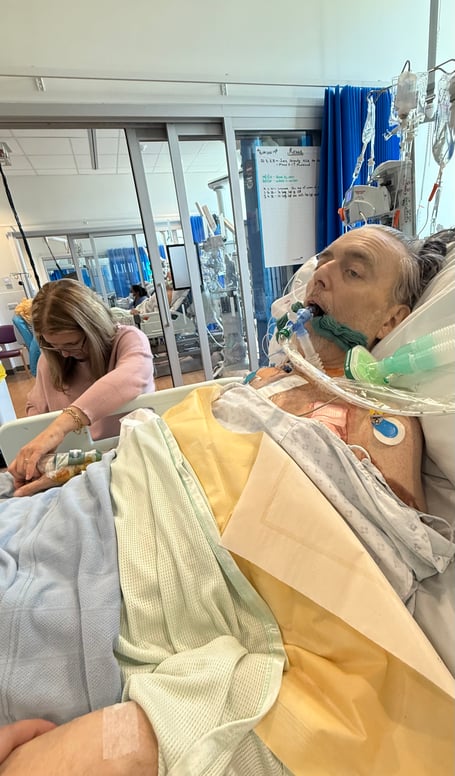
Mike Stamp, 60, was being treated for heart and kidney failure at Frimley Park Hospital when doctors warned his family that he might not survive.
In August 2024, his wife Jo was called to his bedside, while relatives travelled hundreds of miles to say their final goodbyes.
Lying in intensive care, with machines helping to keep him alive, Mike told Jo she could marry someone else. He asked his sons Jack and Luke to look after each other and made his brother and nephew promise to take care of them.
He even showed his wife how to access the family's financial accounts, worried about how she would manage without him.
"Laying on a table as your wife walks past you, telling her that she can marry somebody else, and then telling your sons to look after each other, and then telling your brother and your nephew to look after your sons is the most levelling experience you can go through," he said.
"And what's amazing is you're just calm. There were no tears. You just assume your time is done."
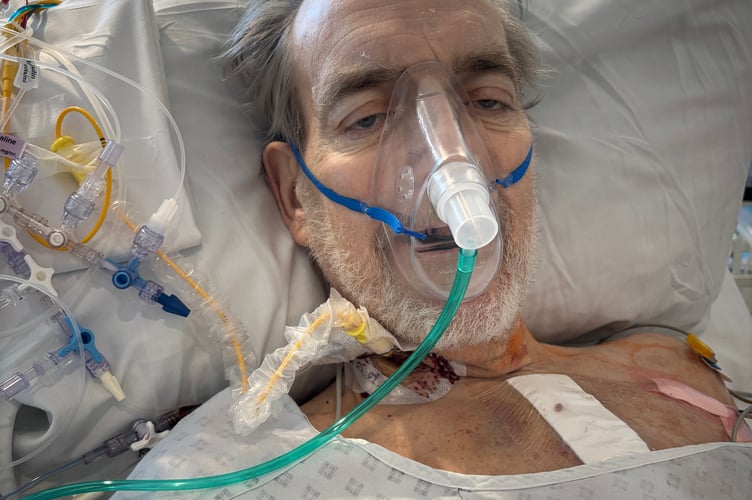
It was the lowest point in a medical ordeal that saw Mike's heart and kidneys fail, his body swell with retained fluid and doctors fight to keep him alive.
But following a life-saving heart transplant at Royal Papworth Hospital in Cambridge 18 months ago, he has rebuilt his strength, competed in the British Transplant Games and been chosen to front the hospital charity's Christmas fundraising campaign.
His illness began more than two decades earlier, when a virus in his thirties left him with dilated cardiomyopathy, a condition that weakens the heart muscle and makes it harder to pump blood around the body.
Medication kept the condition under control for years, allowing Mike to continue a successful career involving international travel and long hours.
But gradually, his health began to deteriorate.
He became increasingly breathless, struggled to climb stairs and developed swollen ankles and severe bloating.
As its pumping ability deteriorated, fluid began accumulating throughout his body.
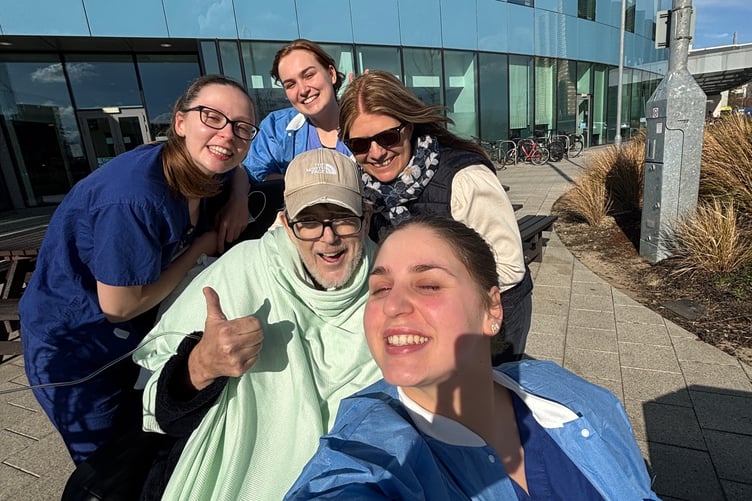
As his heart's pumping ability deteriorated, fluid accumulated throughout his body, causing his weight to balloon to around 124kg, compared with approximately 75kg after treatment.
The swelling became so severe that fluid began leaking through the skin of his legs.
"What happens is you get to a certain stage where your legs can only take so much fluid and then they start to leak," he explained.
"It starts to tear the skin. The fluid leaks out of your legs and runs down your legs like it would down a window pane."
Mike was repeatedly admitted to Frimley Park Hospital, where his condition deteriorated further.
He developed pneumonia, his kidneys failed and he required dialysis. Doctors also performed procedures to restore his heart's rhythm.
It was during this period that his family received the devastating warning that he might not survive.
Mike remembers being heavily medicated and strangely calm, while those around him endured the full horror of what was happening.
"The trauma was on my wife and my kids and my friends," he said.
"I was in there dazed, not knowing what was going on. They're watching me dying. I'm not seeing that.
"Everybody feels sorry for the person. It's the family you've got to feel sorry for."
Eventually, specialists at Royal Papworth Hospital became involved.
Mike was transferred to Cambridge, where doctors removed around 35kg of retained fluid during one admission.
For a while, he improved sufficiently to return home, but the fluid rapidly returned and further admissions followed.
By the time he returned to Papworth, a heart transplant was becoming his only realistic prospect of long-term survival.
He spent months in a specialist cardiac ward, receiving medication to support his failing heart while doctors assessed whether he was well enough to withstand the operation.
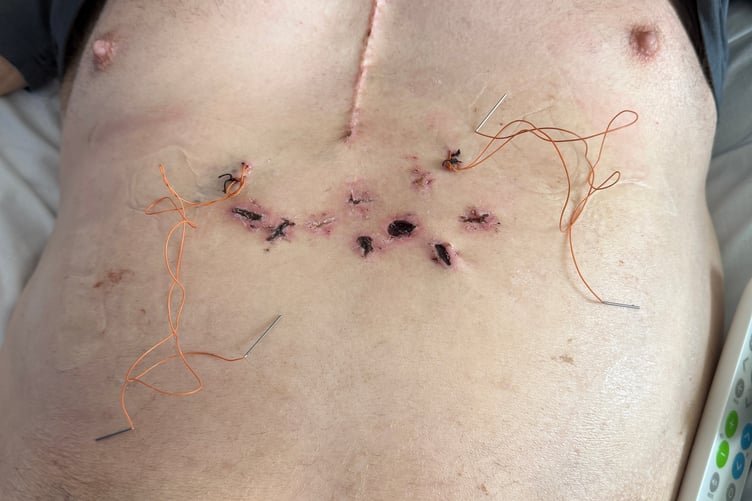
His condition subsequently deteriorated so badly that surgeons fitted a mechanical heart-support system known as a Bi-vad, which helped circulate blood through his body.
He woke to discover large tubes emerging from his chest, connecting him to machinery beside the bed. "I felt like Davros from Doctor Who," he said.
But despite everything, Mike refused to give up hope.
While lying in hospital, he bought himself an Audi RSQ3 sports car, determined that it would be waiting for him when he returned home.
"Me not coming out was never a thought. It was never an option," he said.
Eventually, doctors found a donor heart.
Mike was prepared for surgery, only for the surgeon to reject the organ after identifying concerns about its condition during the final checks.
"There was some furring around the arteries and he'd made a decision that that wasn't right," he said.
Roughly 48 hours later, another heart became available.
This time, the transplant went ahead.
Mike underwent around seven or eight hours of surgery and remained unconscious for approximately two days.
Just 10 days after the transplant, Mike was allowed home.
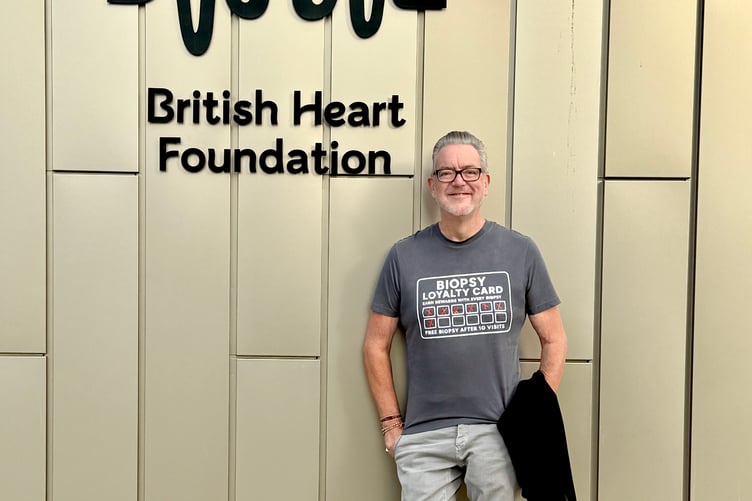
But months of critical illness had left him desperately weak.
An ordinary parcel delivery provided a reminder of just how much strength he had lost.
When a driver handed him a box at his front door, Mike lost his balance and fell backwards onto the hallway floor.
He was unable to get up.
With the front door still open, he dragged himself towards the lounge, eventually using a footstool and chair to pull himself upright.
The whole ordeal took around 20 minutes.
"I had managed to stand up and close a door, two things I would previously have done without noticing," he later wrote.
"The parcel remained on the floor. I left it there. It had already done enough."
Determined to regain his independence, Mike began walking with Jo and their dog before joining Jetts Gym in Farnham.
With support from trainers and physiotherapists, he gradually rebuilt his strength, although some sessions ended in tears of frustration.
"You've got a 59-year-old man sitting on a bit of equipment having a cry because he can't do it," he said. "And then a week later sitting on that bit of equipment having a cry because he could do it."
Mike's determination became something of a talking point among the staff treating him.
At Royal Papworth, physiotherapists set him daily targets for moving his legs and rebuilding his strength.
He repeatedly exceeded them, forcing staff to raise the targets.
"They think I'm the most stubborn person they've ever met," he said. "Which I think is probably accurate. I don't do no."
Within months, he was training regularly, eventually reaching a level of fitness that surprised even his cardiac rehabilitation team.
Although he still bears some impressive scars from the tubes that once helped keep him alive, Mike says he is now feeling remarkably well.
"It's been spectacular," he said of his recovery.
What has been difficult to come to terms with, however, is the knowledge that his second chance at life was made possible by someone else's death and the donation of their heart.
"It's the one topic I struggle to talk about without crying," he said.
"Someone died, or two people died, for me. One heart got thrown in the bin. That's a lot to get your head around."
Because of this, he says he feels a responsibility to make the most of every day.
That determination also led him to enter the 2026 British Transplant Games in Sheffield, competing in archery, discus, javelin and shot put.
Having never previously competed in the throwing events, he spent months training, initially determined to win a medal.
But his priorities changed almost immediately.
As he prepared for the archery competition, he watched another participant being helped out of a mobility scooter.
"I was competing with him," Mike recalled.
"And all of a sudden, it didn't matter anymore.
"I couldn't bring myself to want to beat somebody who'd put that much effort into coming."
Later, watching young transplant recipients competing in running races, some helped around the track by their fathers, reinforced that feeling.
"I was just fascinated with cheering them on and high-fiving them," he said.
"They didn't have a care in the world. All of them were smiling."
For Mike, being surrounded by people who had survived similar experiences proved more rewarding than any medal.
"Outside of having my children, it’s the single best thing I've ever done," he said.
The Games also helped him realise that recovery was about enjoying life, rather than constantly setting new targets.
He continues to train regularly but now devotes considerable time to supporting other transplant patients and their families.
Together with Jo, he participates in online support groups, sharing their experiences and helping people understand what to expect before and after major heart surgery.
He's also using his background in marketing and technology to help Royal Papworth develop more accessible patient information.
And he is writing a book about his experiences, combining the frightening realities of serious illness with his characteristically irreverent humour.
His story has already attracted attention from Royal Papworth Charity.
In December 2025, he spoke about his ordeal before around 600 people at a charity carol service at Ely Cathedral.
Now Mike and his family have been chosen to front the charity's 2026 Christmas campaign, helping raise awareness and funds for patients, their families and specialist research.
He believes one of the greatest challenges for patients is simply not knowing what lies ahead.
"What we went through was horrifying," he said.
"And it was horrifying not necessarily because of what went on. We had no idea what to expect before we went in, and we had no idea what to expect when we came out."
His message to anyone facing a similar diagnosis is to seek medical advice, take their health seriously and not be afraid to ask questions.
"The more knowledge you have, the less frightening it is," he said.
Having once prepared to say goodbye to his wife and sons, Mike now has the chance to enjoy family life and help others.
Comments
We've recently changed our login process. If you have an account for commenting, you will need to re-register on the login window.
This article has no comments yet. Be the first to leave a comment.