
EAST Hampshire District Council has been ordered to remove new fencing and associated works at the Bordon Inclosure after it emerged it was built without planning consent.
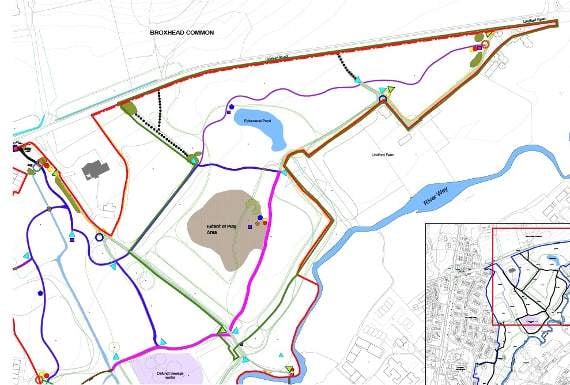
The boundary “error” arose as the northern section of Bordon Inclosure, which is a Suitable Alternative Natural Greenspace (SANG), encroaches onto common land (Broxhead Common).
This means that the fencing which runs alongside Lindford Road, as well as gates and other works, does not have planning permission as it contravenes common-land policy.
The Defence Infrastructure Organisation technically owns the Bordon Inclosure but Whitehill Town Council has acquired a long lease (80 years) which will allow it to manage and develop the SANG.



The council took over the land last January and formally opened it in April.
Town council chairman David Cooper said “vast sums of money were spent” on the fencing and associated works and described the error as “dreadful”.
“The repercussions are expensive,” he said. “You can’t defend this sort of thing.”
Although “a good 80 per cent is not on common land”, the northern part of Bordon Inclosure is, meaning the fencing should technically not have been built in the first place.
“Down comes the inspector,” Mr Cooper added. “Now it’s all got to be taken away.”
Alan Beckett, an inspector appointed by the Secretary of State for the Environment, Food and Rural Affairs, did give permission for some aspects of the project.
However, he ruled that: “Consent is not granted for the erection of the fence alongside Lindford Road or the fence between Lindford Road and Lindford Farm. Consent is not granted for the pedestrian, horse or field gates specified in the application. Consent is not granted for the construction of a natural play area or works ancillary to its construction. Consent is not granted for three interpretation boards, for which no locations have been specified.”
Some parts were more favourably received with consent given for footpath improvements, a bench, an information board, five way-markers (timber bollard signs), and deck bridge.
In a statement to councillors and interested parties, former environmental sustainability lead at the district council, Bruce Collinson, who has now left the council to work for developer Taylor Wimpey, said: “This is not entirely what I hoped for, but it does not undermine the ability of the site to be a SANG and would still promote recreation and improved management of the woodland. The management of users and biodiversity on site does not change, therefore the management arrangements for the site and delivery of the management plan does not change.”
A district council spokesman said this was, at some level, “an error”, and it was a shame the situation had concluded in this way.
“The district council undertook work to improve access and management arrangements for Broxhead Common to the south of Lindford Road, which is immediately adjacent to the Bordon Inclosure,” he added. “Some of the work was not in line with the common-land consent. Footpath improvements, information boards, finger posts and way-markers installed in the area will be retained but a fence along Lindford Road on the northern edge of the site and a fence between Lindford Road and Lindford Farm Cottage must be removed.
“This fence line will be removed in early 2017 and reused elsewhere in the site outside the common land area, but within the Bordon Inclosure.”
The spokesman was unable to verify the cost of the works or the cost of relocating materials at time of going to press.
Following the departure of the Army in 2015, the site was transformed into a SANG (see map) as part of the Quebec Park and Louisburg housing developments.
The day-to-day management of the 60-acre SANG is overseen by the Deadwater Valley Trust under a service level agreement and funded by developer contributions. The Government inspector was became involved after representations from the Broxhead Commoners Association, Natural England and others.
The objectors claimed that the status of this part of Broxhead Common as registered common land was “incompatible with its inclusion in the SANG”.
As public access for “informal recreation on foot to Broxhead Common” is provided for under the Countryside and Rights of Way Act 2000, the inspector said it was “surprising this part of the common had been incorporated into the SANG”.
Comments
This article has no comments yet. Be the first to leave a comment.