
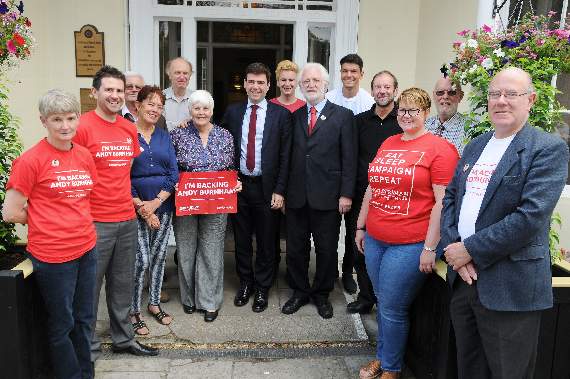
At an Alton meeting organised and chaired by Liss councillor Howard Linsley, campaign leader for the South East, it was standing room-only at the Alton House Hotel venue.
The Shadow Secretary of State for Health, fresh from visits to Guildford and Aldershot, arrived in the childhood town of colleague and adversary Yvette Cooper to address local members before pushing on to similar meetings in Bas-ingstoke and Southampton.
Following a photo shoot at the entrance to the hotel, the 45-year-old MP for Leigh assured his audience that whatever happens in the forthcoming leadership race, he and Yvette Cooper had always worked well together and he had a “huge amount of respect” for her.
-Cllr-Lulu-Bowerman-Tim-Lawton--Image-LDRs.jpeg?width=209&height=140&crop=209:145,smart&quality=75)


“Between us we have a big responsibility to keep this party united,” he said.
The father-of-three began his address by looking at the failure of Labour to win the General Election.
It was his view that the party had become “too Westminster-centric” – focusing on towns and cities, with no real representation in the rural South. And it was currently viewed as ineffective in opposition.
Labour needed to listen again to its members, to return to its roots as a party to represent the country as a whole, and Mr Burnham believed he was the man to do it.
He had decided to take to the road in what was a significant week for Labour – marking the 70th anniversary of the foundation of the post-war Attlee government – “a source of quiet pride for Labour people.”
But, said Mr Burnham, it had led him to pose a difficult question which went to the heart of the party’s current problems: could the modern-day Labour party have created the NHS?
Mr Burnham was certain it could not. “We have,” he said, “lost our ability to think big – to dare to dream.”
Instead of being true to its roots and its members, Labour was out of touch with a large part of the country – and not just Scotland.
“People don’t see Labour as a party with answers.
“We need to restore the courage of our convictions” and spell out “what we stand for in the 21st century,” he said.
He was concerned that many people were finding life much harder now than during the post-war period: many were unable to get close to the housing ladder, or to access a fixed, secure, steady, well-paid job, with families struggling and unable to make ends meet.
They were anxious about their children’s future – about the cost of further education and whether they would get a job. And they were worried about care in old age and how they will be able to cope.
Mr Burnham wants to bring about change. He told those present that his aim was to create “a proper opposition”; to give Labour back a voice; and to rebuild its heart and pride, by addressing, among others, the “misconception” that Labour was responsible for the financial ‘crash’, and challenging the Tory Welfare Bill.
And he wants to “change the way the party works” by re-engaging with the trade unions and the traditional Labour membership.
“Labour will look, feel and sound very different under my leadership,” he said.
Due to release his manifesto this week, Mr Burnham told members that while it would agree with many of the ideas put forward by the Jeremy Corbyn camp, the difference was that he knew how he was going to pay for it.
More radical than any other post-war policy statement, Burnham’s ‘Big Vision’ will include proposals that could transform social care.
He said he feels it should be paid for by taxation under the umbrella of the NHS, giving people peace of mind over care in old age while allowing them to retain the majority of their estate to pass on to their children.
He would advocate giving the vote to 16 year olds; to introduce a national living wage from the age of 16; re-introduce free university education; introduce a UCAS style system for technical education and apprenticeships; free up councils to borrow to build the homes they need, and give them more control over local budgets in respect of the NHS, education, planning, social care, and housing.
Her would also oppose the Tory-led extension to the right to buy, and introduce rent controls in the private sector.
On immigration Mr Burn-ham wants to stay in the EU, would like to bring the referendum forward, and supports freedom of movement whilst stressing that “free to work is not free to claim” – putting a limit on the time before immigrants can claim benefits and social housing.
He wants to stop the undercutting of wages by immigrant labour, and wants an EU fund set up to support those communities most affected by rapid immigration.
And he would like to re-nationalise the railways – a statement that raised a big cheer from his audience.
Pleased with the turnout, Howard Linsley said that, while still behind front contender Jeremy Corbyn in the leadership polls, he still believed Andy Burnham could and would be the right man for the job.
Comments
This article has no comments yet. Be the first to leave a comment.