
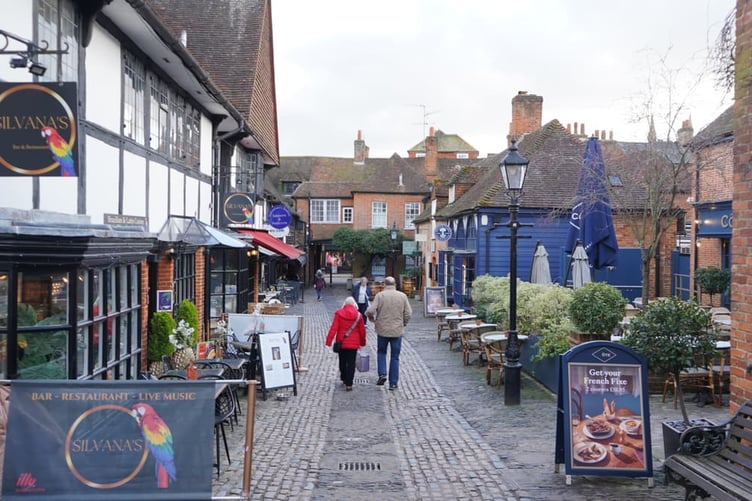
Yard’s paving is quaint but uneven
You recently featured Lion and Lamb Yard in your paper (Peeps into the Past, Herald & Post, October 15). Following the last time this Farnham landmark was mentioned, I wrote to the new management company with a suggestion to improve the ground surfaces.
The current paving over most of the yard may look quaint, but it is very uneven. This can be a real problem for wheelchair users, people pushing children's buggies or even those wearing high heels.
You only have to watch those struggling, especially going up the slope, and the way they move onto the block paving at the top of the yard as soon as they get there.
Surely it should be possible to preserve the yard's historic character while making it more accessible to everyone.
I wrote to the new management company suggesting block paving to replace one of the two surfaces at the lower end. I didn't even get an acknowledgement!
It would be interesting to discover whether other readers agree with my assessment of the uneven surfaces in Lion and Lamb Yard.
Dave Shurlock,
Upper Hale



Fond memories of the Herald’s printing days
I just loved your Reception classes spread (Herald & Post, October 8), although I had never thought of the difficulties your reporter had in compiling it.
Half-term is upon us. I hope the weather is kind so I can enjoy the natural delight of children.
A snuggly fleece over a party dress, with leggings and trainers, is the fashion look for Saturday mornings, and all the new paving stones provide endless opportunities for play that paving stones always have.
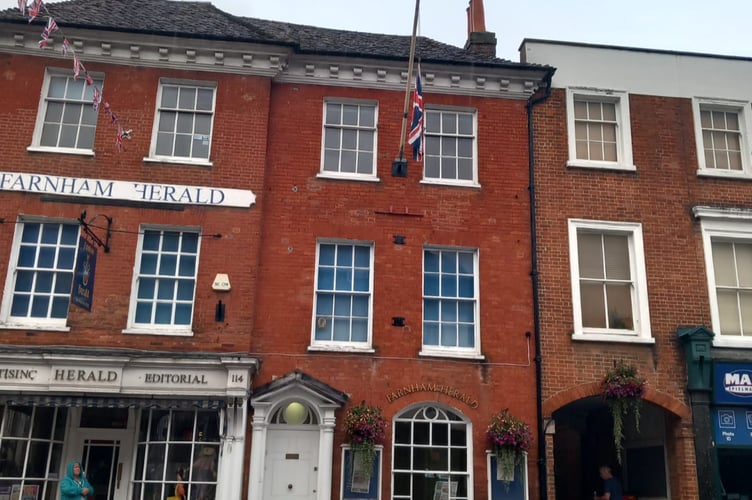
Once upon a time, I was a teacher at what is now Potters Gate Primary School and remember taking my class to the Farnham Herald office in West Street.
We saw the wonderful "inside-out" letters of all sizes being set into the frames, then inked up and finally printed.
We were allowed to handle various items. Were the biggest letters made from that wonderfully tactile boxwood?
Back at school, we experimented with mirror writing and made our own printing blocks using thick, hairy string stuck onto greyboard with "toffee" glue. The inks were definitely not washable then!
It was a wonderful experience for the children, and one I still remember fondly. How different newspaper production must be today!
I still enjoy the hard copy of the Herald but I like the online version too. Two completely different experiences.
I'm pleased that a response is so much quicker and easier electronically. Not sure whether any Farnham Herald editor ever received any of my thought mails!
Linda Harris,
Farnham
Editor’s note: We can confirm this one reached us!
Knit a little hope for bowel cancer
Could you knit or crochet a little hope this festive season for people affected by bowel cancer?
Bowel Cancer UK is inviting stitchers to get sponsored to knit or crochet a star a day, or do your own thing, every day in November.
You can attempt our star, knit a Christmas jumper, crochet tea cosies, sew a special Star of Hope symbol or anything in between!
If you can't stitch every day, you can choose a challenge that suits you.
It's a chance to put your creativity to good use while supporting a cause that touches so many lives.
Your donations could help save lives through earlier diagnosis, improve the quality of life of those affected by the disease and bring us one step closer to a future where nobody dies from bowel cancer.
Sign up today and receive your free online welcome pack, including your knitting and crochet patterns, at www.bowelcanceruk.org.uk/knitting.
Genevieve Edwards,
Chief Executive,
Bowel Cancer UK
The fundraising power of a good book
In an era when public debate can often feel increasingly divided, it is easy to underestimate the power of stories to bring people together.
At ShelterBox, we've seen first-hand how books can build empathy, understanding and global awareness by turning complex international issues into real human stories.
Through our Book Club, readers who pay £10 to £15 a month for their subscription receive books in the post inspired by ShelterBox's work across the world.
They have travelled through the pages of novels, memoirs and short story collections that go beyond statistics and headlines.
This month, our community of readers reached an extraordinary milestone, raising £2 million to support families who have lost their homes after disaster and conflict.
More than 10,000 people have taken part over the past eight years, reading over 160,000 books from 67 countries.
It's a remarkable example of how individual readers, united by a shared interest, can make a real difference to people thousands of miles away.
What makes this achievement particularly special is that it demonstrates how literature can foster a sense of connection in an increasingly fractured world.
As a ShelterBox team puts up tents in Nepal, Book Club members voted to read the Himalayan historical fiction The Last of Earth by Deepa Anappara.
An Unnecessary Woman by Rabih Alameddine immersed readers in the city of Beirut as ShelterBox worked across Lebanon to support displaced families.
And while ShelterBox's partners supported families affected by earthquakes in Afghanistan, the club read the collective journal of a group of Afghan women writers, My Dear Kabul.
When readers engage with books like these, distant events become more relatable, and unfamiliar communities feel a little closer to home.
At a time when many of us are searching for ways to bridge divides and better understand one another, that feels more important than ever.
Find out more about joining or gifting a membership at shelterbox.org/book-club.
Catherine Thornhill,
Head Bookworm (Book Club Manager),
ShelterBox
Comments
We've recently changed our login process. If you have an account for commenting, you will need to re-register on the login window.
This article has no comments yet. Be the first to leave a comment.