
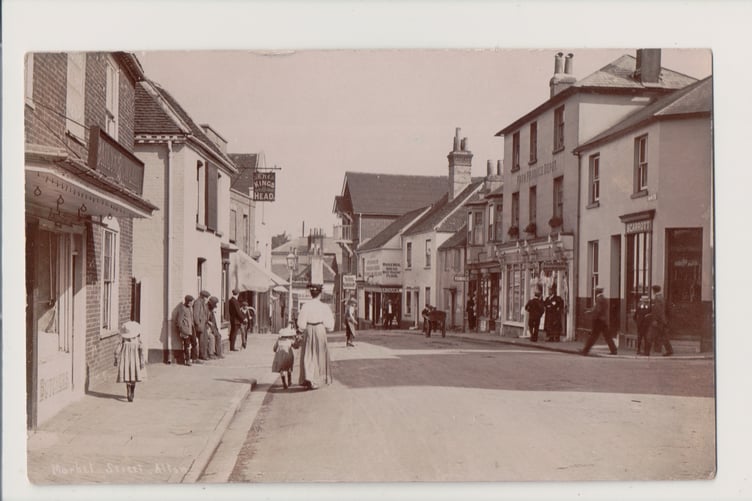
New Year’s Day 2026 was a very special day for Alton’s Curtis Museum, as it marked the 170th anniversary of its opening in 1856, writes Jane Hurst.
In 1837, the Alton Mechanics’ and Apprentices’ Library was founded and William Curtis, son of the William Curtis who was Jane Austen’s Alton apothecary, became its president. The aim was to form a library and give lectures for working men. The name later became the Alton Mechanics’ Institute.
Many of the lectures were on the natural sciences and William Curtis, among others, had a growing collection of objects. By 1854, the Institute was in need of larger premises and acquired 18-20 Market Street. During the next year, William Curtis and his brother John devoted all their spare time to arranging and labelling the collection.
On January five, 1856, the Hampshire Chronicle reported: “A museum in connection with the Mechanics Institution at Alton was opened on New Year’s Day, consisting at the outset of upwards of 4,000 specimens. The museum will be opened every day except Friday, and it is in contemplation to form a natural history class.”
Although there was a large number of natural history items, visitors could also see North American moccasins, Turkish slippers, fish hooks from the Sandwich Isles, clubs from Fiji and a quantity of Eskimo items.
The earliest surviving admissions register appears to date from 1863 and the first items recorded are a “hedgehog and young”, followed by a “rabbit” and a “peregrine falcon” – hopefully all dead and stuffed.
As well as local birds and animals, donations included tiles from Selborne Priory, flint implements and Roman objects. Some gifts came from further afield, including emu eggs and dodo bones.
In 1875, the first catalogue was published and it shows that the collection had grown. It included the paw of a mummy crocodile and “two mummy ibises”, vases and lamps from Athens and Carthage, and large fossils.
The museum now filled two floors and the Institute was outgrowing its premises – as were the Cottage Hospital and public rooms in the Town Hall. Luckily, brewer Henry Hall offered his land, known as Crown Close, to be made available for each to build new premises, all of which opened in 1880.
The Institute continued to grow and offered art and technical classes and, as the museum expanded, an extension was added. In 1890, an Egyptian mummy was accepted and required a large case. After 42 years it was decided that it was “quite unsuitable for a small museum” and it was sold for £25, which paid for more cases.
When the First World War came, the Assembly Rooms opposite became a Red Cross hospital and the museum was closed and used as a hospital store.
After the war ended, it was decided to offer the museum and its contents to Alton Urban District Council as part of the town’s war memorial. The Assembly Rooms and Crown Close itself were also given by the Hall family in memory of Alton’s fallen. William Hugh Curtis then became honorary curator, a post he held for many years.
The Friends of the Curtis Museum held their first meeting on January 17, 1934, and celebrated their 90th anniversary just two years ago. They recognised that life was changing in the 1930s – especially in agriculture – and set about collecting items before they were lost.
Under the Education Act of 1944, the museum and its contents had to be transferred to Hampshire County Council. This took place in 1947, when it was hoped that “the wider ownership would, in the long run, benefit the museum and not detract from its individuality”.
When he wrote The Curtis Museum – The First Hundred Years of a Small Museum in 1955, William Hugh Curtis ended by saying: “The next few years are likely to be difficult and we shall need all the help we can get.”
Comments
We've recently changed our login process. If you have an account for commenting, you will need to re-register on the login window.
This article has no comments yet. Be the first to leave a comment.