
In the early months of 2020, the Covid-19 pandemic swept through countries across the globe, writes Derek Carpenter.
News of its progression spread equally quickly, from a first death in the USA on January 14 to nearly all countries reporting fatalities by the end of March.
The UK’s first death was recorded on March 5. In total about 36 percent of the UK population became infected and 3.4 percent (more than 230,000 people) died. For the first time in our lifetime humankind’s belief in its ability to overcome such infections was seriously challenged, spreading fear and a sense of impending vulnerability to every part of the country.
If three out of every 100 people in the UK died from Covid, imagine your reaction if 33 to 50 out of every 100 had died from the infection.



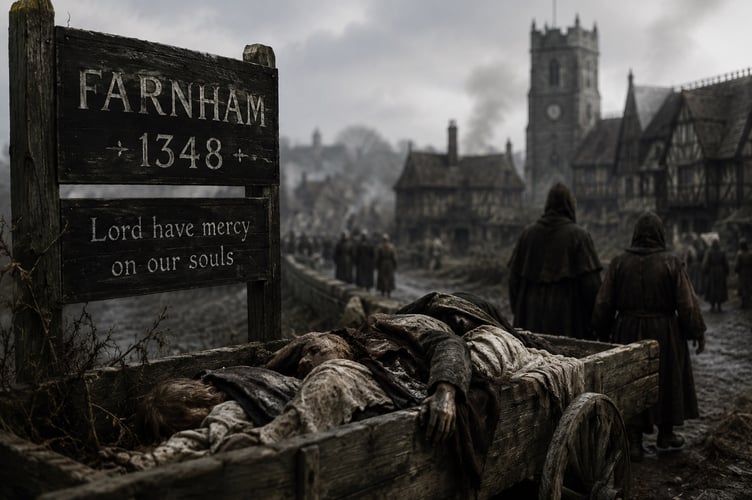
Like many other towns in the country, that is exactly the situation that faced the population of Farnham in 1348; this was the year of a plague, we now call the Black Death. And Farnham’s population was only about 2,000 to 3,000 souls at that time, not the 40,000-plus of today.
If you had lived in Farnham in 1348 you would have known many of the people who succumbed and died of the bacterium ‘ersinia pestis’. Many would have been your close friends. They might have worked the fields next to you. You may have regularly bought or bartered with them for the food they produced or the animals they sold. They could have been directly related to you by birth or marriage.
A few people in Farnham may have been aware of the pestilence some time before witnessing its devastating presence in their community.
There were reports, probably from sailors returning to ports on the south coast of England, of a plague entering ports in Italy via Northern Africa and spreading quickly through Europe.
But this was probably initially seen as being nothing new or of much concern, in the same way that Covid was initially seen before its different contagious and lethal properties were fully understood.
Traces of the Black Death’s ersinia pestis bacterium have been found in English bronze-aged skeletons. The ‘Plague of Justinian’ in the sixth century may still have been spoken about in fireside stories.
And there were similar, though smaller and fewer, deadly outbreaks of the same disease in the 13th and early 14th century. But nothing came close to the catastrophic wave of human destruction about to have a long and lasting impact on communities like Farnham.
By June of 1348, many living in and around Farnham would have been aware that they were facing something new and particularly virulent, and that they now lay in its pathway.
The first concerning reports of the coming of the Black Death to England came from Weymouth and some other ports on the south and west coasts.
In his book Farnham in History’, Roy Waight suggests that people in “Tongham and Tilford were the first to suffer”. The official ‘pipe roll’ accounts of the bishopric of Winchester begin to show a spike in the town’s death rate starting in the autumn of 1348.
Most importantly for Bishop William Edington (the Bishop of Winchester at the time), was the loss to the disease of his Reeve for the castle and manor of Farnham, William Waryn, from Elstead.
At that time a ‘heriot’ tax - a type of inheritance tax - was levied. The Reeve was responsible to the Bishop for its collection.
The tax was typically payable by the bereaved family’s best farm animal to be passed to the Bishop via his Reeve. It was therefore important for Bishop Edington to replace Waryn quickly, and he made John Runwick his new Reeve in Farnham, which seems to have been a very good decision.
Runwick is reported to have been one of the most competent Reeves in the country, very capable and efficient at his job. And he needed to be. In the year from spring 1347 to early 1348 the Winchester pipe rolls show just three animals to have been collected as ‘heriot’ in Farnham.
From late 1348 through to1349 that figure rose to 133. Runwick found pastures to keep some of the best animals properly fed. He kept about 30 horses and foals plus some sheep and cattle but soon had to resort to slaughtering those of little or no market value.
Overall, nearly 100 oxen and cows were killed. After slaughter, carcasses were typically hung in the Great Hall of Farnham castle where they were salted and butchered to preserve them. They kept the Bishop’s larder full, in readiness for his future visits.
1350 saw the end of the devastation of Farnham’s population. The Black Death changed the nature of the town and the country’s economy and furthermore, its social structures.
The loss of swathes of manual labour, artisans and traders distorted the established balance of supply and demand.
Harvests were left to rot in the field, planned works unfinished (including at Farnham Castle itself), and taxes levied to pay for the Hundred Year’s War with France.
All these significantly raised the cost of manpower and that of many basic goods. This left a much-reduced population greatly the poorer and in an increasingly rebellious mood, eventually leading to the Peasant’s Revolt of 1381.
Comments
We've recently changed our login process. If you have an account for commenting, you will need to re-register on the login window.
This article has no comments yet. Be the first to leave a comment.