
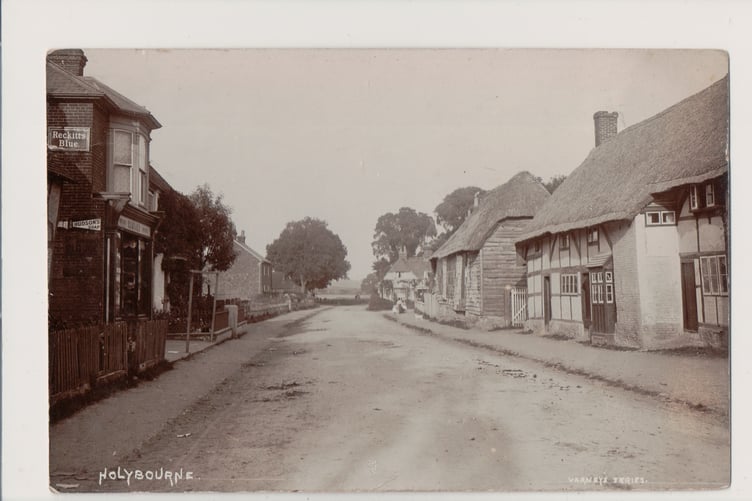
At the eastern end of the village of Holybourne is an area now known as Cuckoo’s Corner, writes Jane Hurst.
People have often wondered how the name Cuckoo’s Corner came about, but this is a case where something has changed over time.
The earliest references name it as Cuckold Corner. Who the "cuckold" was we do not know, nor what happened for this description to come about.
One of the earliest sources found dates from 1808 when, on September 10, there was notice of an intended Bill in Parliament to repair and widen the road from "Cuckold Corner in Neatham to Portsmouth Turnpike Road at Liphook, via Holybourne, Week, Binsted, Kingsley, Broxhead, Headley, Ludshott and Bramshott".
Sadly, this road was never built. It would have provided a direct route from the Alton area to Portsmouth during the Napoleonic Wars.
In 1881 there were six dwellings in the area, occupied by a groom, a shepherd, two agricultural labourers and two carters. By 1937, there were 11 families living there.
On September 18, 1939, an application had been made to Alton Urban District Council, which included Holybourne, for a supply of water to "a military camp which was to be established at Neatham".
A one-inch service was to be installed as soon as the meter arrived. In September 1946, after the war was over, the Urban District Rate Book noted that the Ministry of Works was occupying the "P. of W. Camp at Cuckoo’s Corner" and paying £6/12/4 for the rent of the one-inch water meter. The rateable value was £30 for the half-years ending September 30, 1944, and March 31, 1945.
During the war, many records of military establishments were not kept by civilian councils for security reasons, and these are the first to have been found so far.



While Fisher’s prisoner of war camp at the western end of Holybourne was for German prisoners, it seems that Cuckoo’s Corner Camp was for Italians. Some worked on nearby farms and one or two later married local girls.
After the Italian surrender in 1943, many prisoners became "co-operators". Where they lived was then known as hostels and the men had more freedom.
In March 1951, it was noted that "the Hostel at Cuckoo’s Corner and Fisher’s Camp were Crown properties by requisition and so no action could be taken under the 1946 Act of Parliament".
Three and a half years later, the rate book said that the "Camp at Cuckoo’s Corner" had been transferred from the Crown Property Section to the Main Part of the Valuation List.
The company Anthony H Croucher Ltd was formed in 1953 and later made its home on the Cuckoo’s Corner site, becoming a leading design and manufacturing engineering company.
All this time, the A31 ran through Holybourne and past the garage to Cuckoo’s Corner. Many people will remember the traffic jams, especially at holiday times.
In 1988, the Croucher site was acquired by Clarke Homes Ltd and an archaeological evaluation, followed by a watching brief, was carried out.
The interest was because of the site's proximity to the small Roman town, thought to be Vindomi, which had been discovered earlier.
Sadly, some of the Roman levels had been destroyed by ploughing and the developer’s machinery, but several wells were found together with Roman pottery.
This had mainly been made in nearby Alice Holt Forest and dated from AD200 to AD270. As quite a few Roman coins were also found, it appears the Roman settlement around the town extended this far.
So, although Cuckoo’s Corner seems fairly isolated now, it has been home to Romans and Italians, as well as many local people.
Comments
We've recently changed our login process. If you have an account for commenting, you will need to re-register on the login window.
This article has no comments yet. Be the first to leave a comment.