
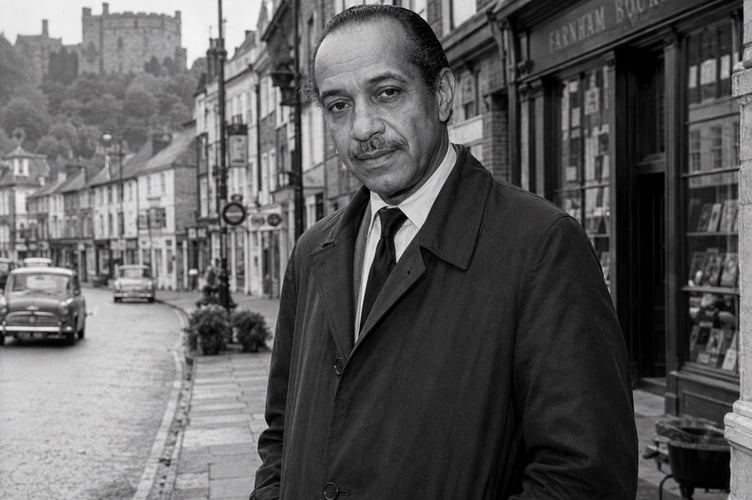
Some 30 people attended the talk, but I wonder how many others realise that this remarkable Caribbean writer once lived — and died — near Farnham?
His death was a tragedy. On the evening of May 5, 1965, Mittelholzer left his home at Lousehall Cottage on Crondall Lane for his customary late-night walk.
The weather was dull and overcast. Behind him, in a drawer, he left two notes — one for his 26-year-old wife Jacqueline, a novelist from Guildford, and the other for the police.



He walked into a field behind his home and set fire to himself. He was found dead at 1am, four hours after leaving the house.
His funeral took place in Farnham on a wet and chilly day.
When his final novel, The Jilkington Drama, was published a few months later, readers were shocked to discover that the protagonist, Garvin Jilkington, escapes his insanity by setting himself alight with fireworks on Guy Fawkes Night — a grotesque literary prelude to Mittelholzer’s own death.
Mittelholzer was the first West Indian novelist to establish himself in Europe. He wrote around 24 novels and two works of non-fiction. About a dozen are still available on Amazon and occasionally appear in the Oxfam bookshop.
He wrote about Caribbean history and his own experiences there. As Wikipedia puts it: “They feature a cross-section of ethnic groups and social classes, dealing with subjects of historical, political, psychological, and moral interest.”
Mittelholzer was born in 1909 in British Guyana and was of mixed descent.
His childhood was not easy. His father’s violent — though purely verbal — outbursts terrified the young boy.
From an early age he appears to have rebelled against his middle-class colonial surroundings. He worked in a variety of modest jobs while beginning to write and publish locally, his first publication being Creole Chips in 1937.
In 1947, Mittelholzer decided to move to England, convinced it was the only place where he could truly succeed as a writer.
He worked quickly, often straight from the typewriter and rarely producing rough drafts. He was passionate about Shakespeare and frequently quoted long passages from memory while walking around Dippenhall.
He loved Wagner and was listening to the Ring Cycle shortly before his death. He admired Nietzsche and, in literature, loved Charles Dickens for his mastery of the grotesque and sinister. He also admired T S Eliot and travelled everywhere with pocket editions of Four Quartets and Fitzgerald’s Rubaiyat of Omar Khayyam.
He loved England and, uniquely among many of his Caribbean contemporaries, regarded it as his mother country.
Edgar was a man of routine. He rose early and prepared breakfast, shopped and visited the library in the morning, wrote in the afternoons, and read or listened to the radio in the evenings — television was still uncommon at the time.
Among the lighter books he enjoyed were the original James Bond novels, which he borrowed from the local library along with many others. He also liked a brief afternoon rest and an evening walk.
He smoked a disciplined five cigarettes a day and often attended performances at the Farnham Rep with his wife.
He became a familiar sight in Farnham — a tall, striding figure carrying a large hold-all while shopping around town. He liked to be in control and do things his own way. When shopping, Edgar meticulously recorded the prices of everything he bought, noting each item carefully as he went.
His conservative views made him unpopular with many fellow writers and his books gradually fell out of fashion.
He later experienced financial difficulties and personal struggles in the years before his death.
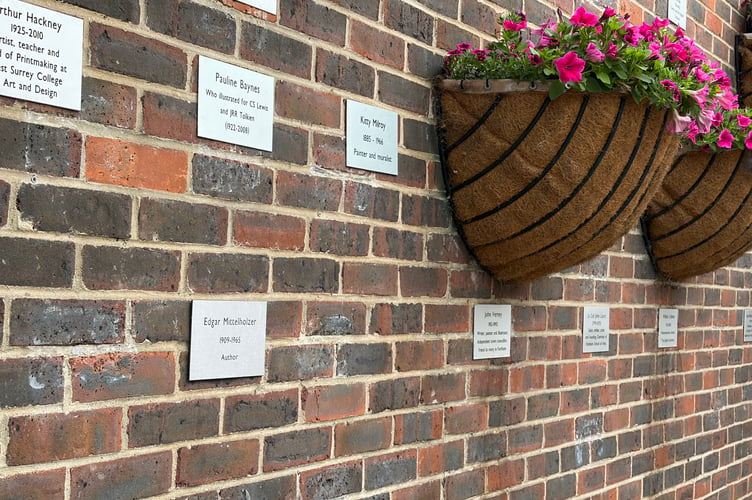
From my own brief reading of his work, I would judge him a great writer. I hope his spirit is pleased that, in 2025, his name joined others on the Notable Names of Farnham wall.
Comments
This article has no comments yet. Be the first to leave a comment.