
BORDON and surrounding areas are pulling their weight when it comes to conserving some of the rarest habitats on earth.
An area of heathland the size of 70 football pitches (50 hectares, 124 acres) has been conserved over the past year through the Heathlands Reunited project.
This has seen a partnership of 11 organisations in the South Downs National Park working together to create, what the project says, are “bigger, better, more joined-up heathlands”.
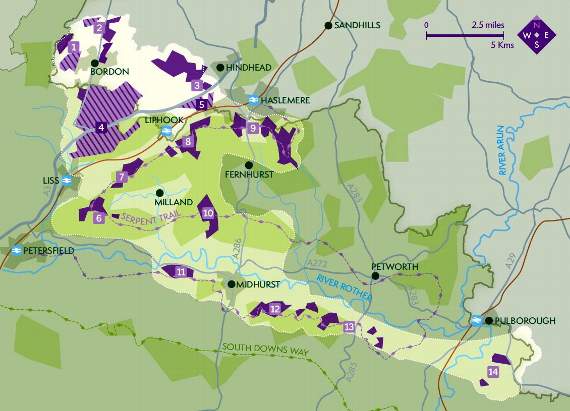
The five-year project, which started in 2016 and covers 34 heathland sites, is supported by a £1.44m grant from the Heritage Lottery Fund, and includes the Slab and Warren sites and Shortheath Common (1 on map); Kingsley Common and Broxhead Common (2); and Woolmer Forest and the Longmoor Enclosure (4).



Heathland conservation includes scrub removal and creating patches of bare ground needed by many rare amphibians and reptiles. A National Park spokesman said that without conservation management “heathlands would disappear, along with the internationally rare species that rely on them”.
The 50 hectares (ha) of heathland includes: The equivalent of 14 football pitches (10 hectares) of scrub cleared; just under 10 football pitches (seven hectares) of non-native invasive species removed; just under 33 football pitches (23.5 hectares) of bracken treated and 14 football pitches (10 hectares) of linking habitat created.
Woolmer Forest and land at Longmoor has contributed to the project, as have Kingsley and Broxhead commons.
Heathlands Reunited is now planning to recruit two apprentice rangers, as well as supporting grazing projects.
The Wildlife Trust says that although it is one of the most wild-seeming landscapes, heathland has actually been shaped almost entirely by human actions.
“It began at least 5,000 years ago, when humans started clearing trees growing on infertile soils, probably to entice game into clearings to make hunting easier, and later to graze livestock,” according to the Wildlife Trust.
“In some areas, layers of charcoal show that the forest was cleared repeatedly by fire for grazing or temporary crops.
“Most heathlands are thought to date from the Bronze Age some 3,000 years ago.”
The work will create wildlife corridors in the National Park, forming an area of heathland greater than 1,200 football pitches by the end of the five-year project. Find out more at southdowns.gov.uk/heathlands-reunited.
Comments
This article has no comments yet. Be the first to leave a comment.