
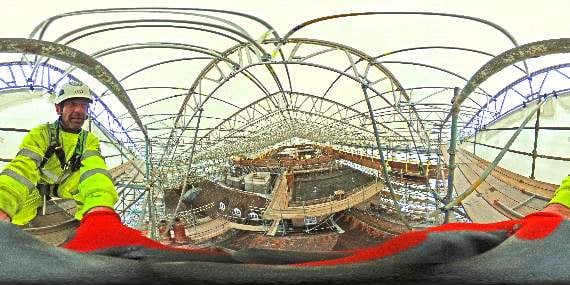
A NATIONAL Trust conservation project to save the roof of a former Tudor ‘power house’ in Hampshire has won two prestigious heritage awards from the Association for Heritage Interpretation.
Now The Vyne’s unique roof conservation project, which has attracted more than 109,000 visitors to its rooftop walkway since March, is in a race against time to win votes that could secure the property’s future.
The project has been accepted as a nomination by insurance company Aviva Plc, in its Aviva Community Fund competition. The deadline for votes is next Tuesday, November 21.
With enough votes cast by then, The Vyne would be entered into the finals, where a judging panel could award funding that will help ensure its survival.




The Vyne has stood for more than 500 years and played host to a royal visit argued to have impacted the course of the Reformation. But today urgent repairs are under way following a violent storm in December 2013 that caused water to leak into the house. The entire roof is undergoing a £5.4m restoration project and has been fundraising throughout the build programme.
UK residents can support The Vyne by registering on the Aviva Community Fund website and voting for The Vyne Roof Restoration Project by November 21. Each voter can cast up to 10 votes to projects of their choice.
Once home to King Henry VIII’s Lord Chamberlain William Sandys, and visited by the king on several occasions The Vyne, near Basingstoke, won the awards for its innovative layout inside the house, called ‘Lifting the Lid at The Vyne’.
At the recent Association for Heritage Interpretation 2017 Discover Heritage Awards ceremony, The Vyne won the association’s highest accolade, the Award for Excellence in Interpretation, as well as best in category securing the Museum and Historic Properties and Sites Award.
Other renowned candidates included the British Museum, Kew Gardens, Tintagel Castle (English Heritage) and Hampton Court Palace (Historic Royal Palaces).
Kathryn Allen-Kinross, assistant project curator, was one of the representatives to accept the awards on behalf of The Vyne. She said: “To win these awards is a fantastic achievement. Everyone involved has worked incredibly hard. We are all very proud of what we have accomplished and truly delighted to receive this recognition.”
Bill Bevan, Association for Heritage Interpretation chairman, said: “Lifting the Lid at The Vyne is a very worthy winner in what was an extremely competitive category. It was chosen as overall winner because the judges recognised the project’s successful aspirations to turn major renovation work into an opportunity for innovative interpretation, in a way that is an exemplar to other historic houses.”
The Vyne used the roof project to reinterpret the experience inside the mansion, where visitors are free to roam rooms featuring items of the collection displayed in a unique storage layout. The exhibition also considers The Vyne’s historic significance, revealing why the house needed rescuing.
The central focus of ‘Lifting the Lid at The Vyne’ explores a key moment in The Vyne’s history - a royal visit argued to have impacted the course of the Reformation. Stepping back into the 16th Century, members of the public find themselves immersed in the visit of Henry VIII and Anne Boleyn in October 1535.
Specialist research was undertaken with the Universities of Oxford and Southampton to enable the team at this National Trust property to thread together the details of this event. In the Stone Gallery, animation of richly decorated moving tapestries and enchanting Tudor melodies transport visitors back in time, where they can discover the power and politics of Henry’s court.
The highlight lies in The Vyne’s rare, Pre-Reformation chapel, where the team have faithfully recreated a Tudor mass ‘soundscape’ as King Henry would have heard it almost five centuries ago.
As well as striving for rigorous historical accuracy, painstaking work ensured the acoustics of the recording were realistic for the chapel’s intimate space. Visitors can gaze up at the chapel gallery where they’ll see a life-size image of the infamous monarch. This is where Henry would have heard Mass.
A key section of The Vyne’s Victorian history is also illuminated in this exhibition. The mansion’s last major roof repairs took place from 1842 and the works were carried out at great expense by William Lyde Wiggett Chute, severely hampering his family’s prospects.
If it hadn’t been for this sacrifice, The Vyne, with its celebrated Tudor chapel and Oak Gallery, as well as its magnificent eighteenth century neo-classical staircase hall, would not be here today.
Visitors have until the end of January to explore the house and the rooftop walkway before the project ends.
To register and vote, visit the website community-fund.aviva.co.uk.
For more details about The Vyne, visit nationaltrust.org.uk/the-vyne.
Comments
This article has no comments yet. Be the first to leave a comment.