
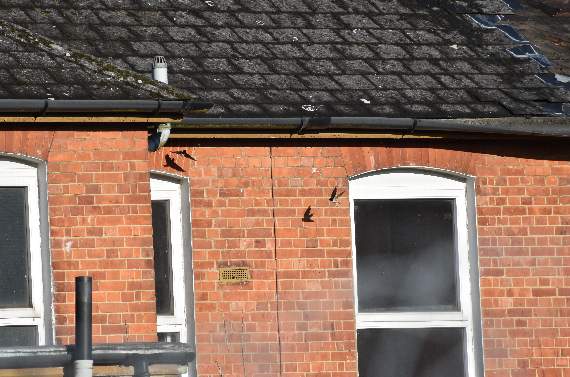
Town naturalist Stephen Miles called in the charity, alleging that developers working at Louisburg Barracks, in Bordon, have been causing “illegal” damage to protected housemartin and swift nests on the site.
But developer Barratt David Wilson Homes has insisted that it takes protecting wildlife “seriously” and had worked with the county ecologist to make sure it complied with the law.
In June, Mr Miles photographed what he claims to be proof of contractors damaging nests. He said it was “criminal” they had been given the go ahead to demolish buildings currently used by migratory birds.


“If I, an amateur, can observe these birds and photograph them readily why could they not do this?” he said. “I do not know how many visits the ecologists made since these birds returned to England in May or how long they spent checking the buildings out?”
Mr Miles has long been worried about the impact on wildlife in the town as the Whitehill and Bordon redevelopment project gathers momentum. And he is so concerned about this latest incident at Louisburg, where 500 homes are set to be built, that he has written to East Hampshire MP Damian Hinds and made contact with the RSPB.
“Following a site meeting last Friday (July 1) the northern half of building eight will be retained for the time being - it has an active house-martin nest in which I spotted at this meeting - as well as the whole of building 11, which has at least five nesting house martins and at least one pair of swifts nesting in it,” Mr Miles said.
He added “building eight also had two swift nests in its central west face and a house-martin nest”, which he spotted on June 25. But by Friday, July 1, he said, the birds had “deserted the nest”, having been “deliberately disturbed”, “which I consider to be an offence”.
“What a needless and cruel tragedy - an indictment of the attitudes of all the organisations whose names are on the site board,” he said.
“At my request the RSPB has now taken up the issue of securing the half of building eight and the whole of building 11 with Barratt so all these migrant birds can complete their life histories up to the end of September and rear their young, which they come, all the way from Africa, to Bordon to do.”
An RSPB spokesman confirmed that the society had become involved.
“House martins and their nests are fully protected under the Wildlife and Countryside Act 1981,” he said.
“We have contacted the consultants working on behalf of the developer and are reassured that they are fully aware of their legal responsibilities.”
Jon Green, construction director at Barratt Homes, said: “Active house martin nests have been identified on a number of buildings during pre-works ecological inspections on the development in Bordon.
“The structures with active nests have been fenced off and nests will remain in-situ and undisturbed until all nesting activity has ceased as per the Ecological Mitigation and Management Plan submitted as part of the planning application for the site and fulfilling the requirements of the Wildlife and Countryside Act 1981 (as amended). We will continue to work closely with East Hampshire District Council and its ecologist to make sure that works on site proceed in accordance with all wildlife-protection legislation and policy.”
Managing directer at Barratt Homes Tim Hill has said previously that the company “takes its commitment to the environment and wildlife extremely seriously” and that all work had been carried out “with the approval of the county ecologist and East Hampshire District Council planning”.
“No building with any sign of nesting has been demolished and we have worked closely with ecologists at all times and have ensured we follow the agreed ecological mitigation management plan,” he said.
Comments
This article has no comments yet. Be the first to leave a comment.