
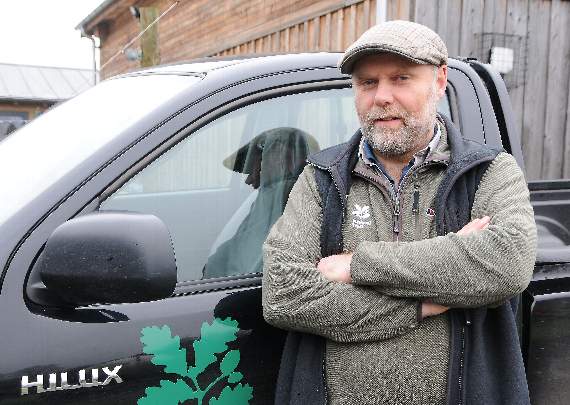
If they have, they could help the National Trust’s conservation work by buying a cow and putting it out to pasture.
Chris Webb, the National Trust’s head warden for East Hampshire, is working, with his team of four, to restore the village commons to their original wood pasture habitats. The New Forest is a classic example.
In commons where amid woodland large stretches of open heath are grazed by cows and horses, grass, weeds and bushes are kept under control and wildflowers can grow and small mammals can find suitable habitats.

A combination of woodland and pasture also encourages more birdlife to move in and nest, said Chris, who is a member of Selborne’s Cobb family who can trace their farming ancestry in the village back to the 16th century.
“For hundreds of years commoners, including my family, grazed cattle on Selborne Common and they and their animals maintained the land,” he said. “It was the same on neighbouring commons - in fact, doing the job we are doing today.
“However, this ceased on Selborne Common in the 1950s and on Ludshott in the 1930s and shrubs and trees began to take over.
“Now there are just two commoners who graze their animals.”
To qualify for commoners’ rights, he explained, “it isn’t the land you own but the house”.
“Several homes in Selborne do come with commoners rights,” Chris said. “That is if the then owner recorded it on the Commons Register in 1965. If they didn’t, then the rights are lost forever.”
Because grazing animals are critical to its conservation work, the National Trust has introduced both cattle and horses on many neighbouring commons, such as Blackdown and Hindhead.
Chris and his team have welcomed this move because conservation is their main role which they devote their working days to.
Chris, whose timber headquarters are tucked away in woods on the edge of Liphook, has been with the National Trust for 31 years and before that he worked for the Forestry Commission, which he joined after having attended Amery Hill School in Alton and, before that, Selborne Primary School.
He grew up in a happy family home, with his mother Daisy, father Len, and with an older brother in what was then a much more rural and peaceful Selborne.
“We used to play on our bikes in the road when we were children or in the woods and fields,” he said.
“We had several shops and five dairies in the village. As little boys we used to help the farmers walk the cattle through the village. Imagine trying to do that now with all the traffic.”
It all changed when a Government widening scheme was carried out, in the early 1980s, on the narrow country road (B3006) leading from Greatham to Selborne so nuclear Cruise missiles could be transported between Greenham Common, near Newbury in Berkshire, and Farnborough. This opened up the road to traffic and Chris can still remember, as a schoolboy, seeing the missile convoy coming through the village “at a very slow rate”.
His love of outdoors comes from his farming background and his Selborne ancestors - the Cobb and Cook families. The Cobb farmhouse, Honey Cottage, still stands in the village not far from the famous Zig Zag, which his great-great grandfather helped to transform from a slippery narrow path into the pleasant walkway it is today. “He also helped to dig the Selborne to Alton road in 1890,” Chris said.
Another ancestor, John Cobb, was sentenced to two years hard labour in prison for his involvement in the Selborne and Headley Workhouse Riots of 1830.
“He narrowly missed being deported,” said Chris. “His plea at the trial was that he was drunk at the time.”
Another relative, Benjamin Smith, received six months’ hard labour because he was quite young.
“You could say my family burned down Headley Workhouse” he laughed.
Working as a young man for the Forestry Commission, Chris was almost following in the footsteps of his father, who had been an inspector for a timber merchant in London’s Docklands and later became a senior member in the firm and a specialist on wood from all over the world.
“Although he held an important position in the company, my dad never drove,” Chris said.
“For 31 years he cycled to Alton Station and back in all weathers. On dark nights in the winter he would say that he hoped a car would come along as it was so lonely cycling along there.”
Chris trained at Alice Holt before working in Forestry Commission woodlands in the area to keep them well maintained and healthy. “Because we have become such a global society, pests and diseases that we never had before are brought here on wood and goods from all over the world and cause a threat to our natural habitat, such as the latest one, ash dieback, which is worrying us.”
The 1987 storm cut a swathe through Hampshire, as it did the rest of England, leaving thousands of fallen trees in its wake.
Much re planting had to be done although, recalled Chris: “Storms are a natural part of nature and if we humans weren’t here the woods they destroy would regenerate themselves.
“That is why we did, and still do, leave some pockets of woodlands to regenerate themselves.”
In the Second World War forests planted by the Commission, after it was founded in 1919, reduced the need to import wood and, in those days, “Timber Jills”, the equivalent to the Women’s Land Army, used to fell the trees with axes, Chris said.
“Today we have a machine that can fell even the largest tree with just one giant blade which cuts down the labour force needed.”
Tree preservation and maintenance is a very important part of the work of the National Trust, but Chris and his team are mainly involved in its conservation.
“It is vital we do it otherwise we would be failing as a charity to do our job and much of our recent work has been working on the commons we look after, opening them up to restore them to their original heathland.
“As a result, we have seen a growth of wildflowers and also an increase in butterflies, with two we thought were lost - the Duke of Burgundy and the brown hairstreak - seen in Selborne last summer. Also, we have more song birds nesting, and the open heath and surrounding woodland make good habitats for small mammals and insects.”
To keep nature looking like nature is a year-round job, but one that makes Chris and his team proud to be protecting and enhancing Hampshire’s countryside.
With East Hampshire boasting some of the finest trees in the country, Chris was asked if he had a fav-ourite tree. “Yes the pollard beeches on Selborne Common which were once pollarded by my great grandfather in the early part of the last century. I like walking by them.”
Comments
This article has no comments yet. Be the first to leave a comment.