
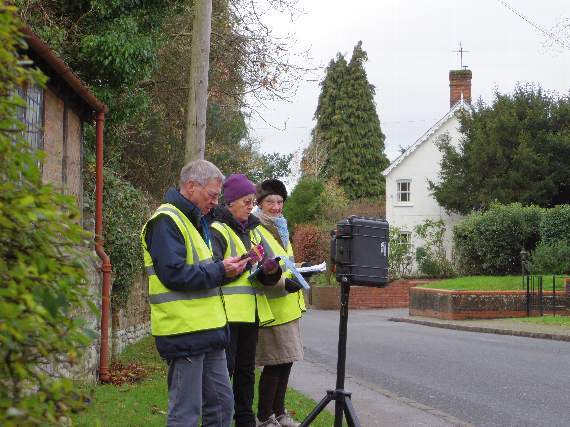
A LINDFORD motorist has criticised the community traffic-calming initiative SpeedWatch as some volunteers “hide behind large hedges” in order to catch people out.
Charlie Osgood suggested that, by not giving approaching motorists a clear view, the practice could constitute “entrapment”. And he is urging anyone who feels the same to contact Hampshire Constabulary to complain.
While “not anti-SpeedWatch”, Mr Osgood has written to the Herald on a number of occasions berating the fact that some SpeedWatch volunteers are not, in his opinion, following the approved code of practice and staying clearly visible at all times. He said he had raised this concern with the police but had seen no change to date.
He flagged up sites in Headley - one in Crabtree Lane where he was caught for speeding - claiming that the volunteer with the speed gun was only visible to drivers “in the rear view mirror after passing the camera”.



More recently another place was in Chawton End Close in Four Marks where, he claimed, a SpeedWatch volunteer was effectively “hiding” behind a large hedge.
However, Four Marks SpeedWatch co-ordinator Reg Pullen argued that all volunteers wear high-visibility jackets so they can be clearly seen, and are trained by the police to carry out the process. None of this would be a problem, he added, if drivers kept within the speed limit.
Mr Osgood told the Herald: “I appreciate that the scheme was set up to reduce the risks presented by people speeding, but there is little value in hiding, and catching people after they have sped past, if drivers could have been slowed down through the village by being visible.
“As a driver, all you can see as you approach is the device telling you your speed, with no indication that the device is manned with people recording number plates.
“If the volunteers were visible, drivers would see them in advance, slow down and drive at the correct speed through their village.
“Instead, they notice that there are no volunteers only to then slam on the brakes when they see them at the last minute, thus causing the roads to be less safe than if they were not there.
“It strikes me that this has become more of an exercise of vigilantes forwarding the details of as many ‘caught people’ as possible, rather than genuinely wanting to make their villages safer.”
In suggesting that the scheme appeared to have “lost its way”, he added: “Ironically, we wouldn’t accept it if police were hiding with cameras - in fact, they even have to have speed camera signs up, and yet we accept members of the public sending our details to the police for their action.”
SpeedWatch is a community initiative that can only take place in 20mph, 30mph and some 40mph zones. Once set up, schemes are managed by the police but run by volunteers, who use top-of-the-line equipment that can monitor the speed of passing traffic and record the details, which are later added to a database.
Vehicle checks are undertaken by the police and letters are then sent to the registered keepers advising them of the speed infringement.
In East Hampshire, Community SpeedWatch was pioneered in Selborne where the first scheme was launched in 2012. With around 8,000 vehicles a day travelling through the village, the scheme was introduced in a bid by residents to encourage drivers to adhere to the 20mph speed limit.
SpeedWatch is seen as the “first tier” in the police’s response to speeding and is about education “not enforcement”.
Volunteers are required to wear high-visibility clothing and, according to the Community SpeedWatch Code of Practice, are “not to conceal their presence from motorists”. As well as being “fully visible”, camera operators are advised to “avoid eye contact with drivers”.
Belinda Kinsley oversees the Community SpeedWatch initiative for Hampshire Constabulary from a volunteer perspective.
She said SpeedWatch was a “non confrontational, educational scheme”, which hoped to draw drivers’ attention to the “fact that speed is a contributory factor in road traffic incidents”. “The volunteers who make up the SpeedWatch schemes have all been trained by the police in relation to operating the equipment, health and safety, recording of information and also on procedures in relation to the actual activity by the side of the road,” she added.
Comments
This article has no comments yet. Be the first to leave a comment.