
IF YOU frequent the National Trust’s Black Down estate, then you might have seen Alexander Fairchild crouching in the heather. If not, you can be sure he has seen you. But don’t be alarmed: Fairchild’s interests lie solely in the search for a creature he calls ‘The Beast of the Black’.
Fairchild came to my attention when I spotted him perched high up a tree, binoculars in hand, one weekday afternoon in February. I thought little of it and carried on walking my dog. A day later, though, I saw him up the same tree, as if he hadn’t moved.
“I haven’t moved,” he barked back at me when I asked if everything was okay. “To see the beast one must become the tree.”
Although I was struck with curiosity at what he meant by “the beast”, I was more concerned about how he managed to eat, sleep or dare I say it, take toilet breaks while up a tree for two consecutive days.




Fairchild did, however, clarify what he was searching for. “Bigfoot, Sasquatch, Alma, Yeti,” he uttered as if speaking not to me but to the wind. “So many names for such an elusive creature.”
The conviction of Fairchild’s words and the sincerity in his voice intrigued me. Eagerly I asked to meet him at a later date to document his search and, just maybe, catch a glimpse of ‘The Beast’. Fairchild agreed.
What follows is the most bizarre experience of my life:
Saturday, March 20
6.02am: I arrive at our prearranged meeting point on Tennyson’s Lane. Fairchild is draped head to toe in makeshift camouflage. “You’re late,” he grunts as he strides ahead toward the trees of Black Dog Copse. I follow and try to keep up but always seem to be lagging behind. We stop among the trees and make camp for the day. No more words are spoken. Fairchild seems agitated. I decide to take a back seat and observe his process.
8am: Still no conversation.
9.15am: Nothing. I make up my mind that I will try to initiate a dialogue before 10am.
9.45am: I decide enough is enough and attempt to ask him a question. “Shh. Quiet,” he hisses at me. He stares intensely through the leaves. I’m beginning to regret this whole thing.
12pm: At precisely midday, Fairchild’s mood abruptly changes. He jumps to his feet and announces, “that’s lunch.”
Over peanut butter sandwiches and Penguin bars we finally begin to converse.
I start with the obvious question: why is he so convinced that such a creature exists at Black Down in the first place?
According to Fairchild, while lost in the woods as a child (some time in the 1980s), the creature sprinted across a path ahead of him.
Then, on his 13th birthday, he took a tumble down a steep hill and found himself face to face with the ‘Beast’.
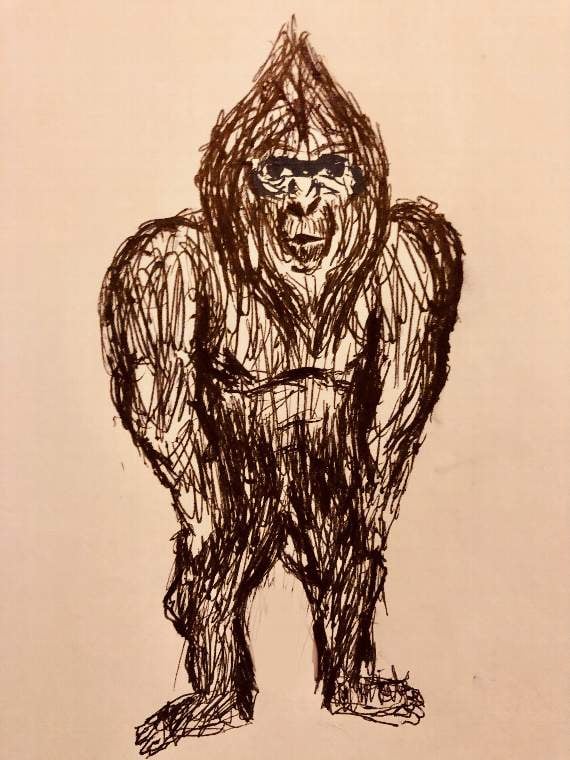
“Eight feet tall he stood, eyes as black as pitch, with thick auburn hair.” He pauses and sucks air through his nostrils.
“And a stench I won’t soon forget.”
Since these encounters, Fairchild has devoted much of his adult life searching for the creature.
Things take a turn for the weirder when I ask him what he thinks the creature actually is, and how it has remained hidden all this time.
His brow furrows, his tone becomes stern.
“I don’t think about what, how, if, nor why!” He is solemn. “All I think is, when? When will I be reunited with the Beast… The Beast of the Black.”
My instinct tells me to stop the interview here and leave Fairchild to it, but my curiosity gets the better of me.
“What do your friends think about it?” I ask. For the very first time he looks me dead in the eye. I feel a chill run down my spine.
“Friends?” he shouts, loud enough to spook any beasts lurking nearby. He stuffs an entire Penguin bar in his mouth, his third. He doesn’t blink once.
“The Beast won’t allow for friends,” he splutters, showering me in Penguin bar crumbs.
I make my apologies and thank him for his time. Before I leave he quickly poses for a photograph, exhibiting an uncharacteristic smile.
He passes me a scrap of paper, a sketch of his “Beast” (pictured). “I draw one every day,” he says, now looking away. “So I never forget.”
As I begin the walk back to my car, I feel torn. The sympathy I feel for the man is underpinned by a strange sense of admiration; for the devotion to a cause most would consider bizarre, and for a soul that has never lost its sense of childlike wonder.
By Flora Islop
Comments
This article has no comments yet. Be the first to leave a comment.