
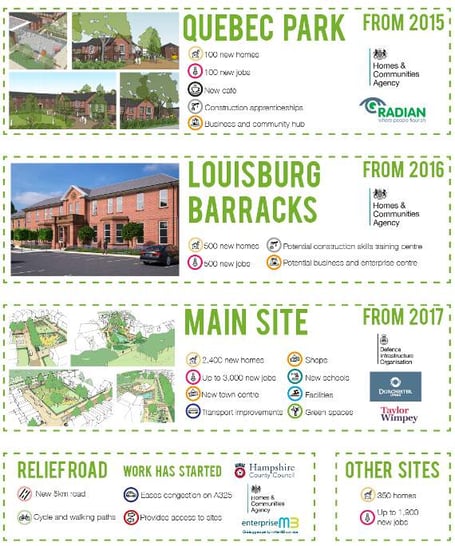
The meeting heard that if 2015 was to be thought of as a year filled with “planning”, then this will be the year of “delivery”.
James Child, project lead at the Whitehill and Bordon Regeneration Company, told residents that, as the Army had left the town, it had “lost some of the traditional heritage”. So now was the time to “create a new legacy”.
This is something he is “passionate” about as, with such a long timescale, he said the project will “certainly see my career all the way through”.

However, he recognised that change is “a difficult thing” and explained that in spring and summer there will be a far clearer picture of the company’s outline plans to build 2,400 new homes and a new town centre.
When this happens, Mr Child hopes residents will step up and provide welcome feedback. “We want you to criticise what we’re doing, we want to hear all your ideas on how we can do it better,” he said.
Mr Child also explained ongoing efforts to fill the 1.4 million square feet of partially used former Army buildings. By the end of this year, he hopes that approximately 60 per cent of them will be occupied by businesses.
Superfast broadband will be available in and around Prince Philip Barracks by April - which will be a step towards creating a “digital hub” and will become a “real community asset”.
Project director Steve Pearce outlined short-term plans, with 2016 seeing 150 new homes built, the first phase of the relief road completed and construction on the Future Skills Centre and the Business and Enterprise Centre starting at Louisburg Barracks.
“There will be a lot of activity, and by the end of 2016 we’ll be much clearer about the detail of the facilities in the new town centre,” he said.
Members of the public were invited to ask the panel questions.
Bill Wain wondered how long before the exhibition house, which neighbours the eco station, would be occupied.
As it is an unusual building - built exclusively to show off a wide range of technology - finding someone to buy or rent it is not straightforward.
Mr Pearce explained it was his hope that, instead, the house would be handed over to an educational institution that could make good use of the facility.
The ongoing topic of the town’s name was raised by Eileen Grinter, who wondered whether a rebranding was off the table.
East Hampshire District Council leader Ferris Cowper said he had really wanted “a serious debate” about changing the town’s name, as there were problems with “Whitehill and Bordon”.
However, he added it was felt that the time for such a move had long since passed and to change the name now could run the risk of dissuading potential businesses hoping to move here.
He explained that, as they were “marketing the town intensively”, its name was already “out there”, so now would be a “bad moment” to introduce any confusion.
Poor transport is a resounding issue for residents and the idea that someone might be able to move to Whitehill and Bordon and then commute to London was said to be “an illusion” because linking up with stations to get to Waterloo is no mean feat.
While Mr Cowper admitted that there was “no solution yet” for this issue, he said there was a “total commitment” to improve transport infrastructure.
He said that Whitehill and Bordon gets “everything we ask for” in terms of finance from the Enterprise M3 LEP (Local Enterprise Partnership), so he expected more money in the pipeline to address these concerns.
Mr Pearce added that he hoped to develop a “public transport system that responds to express wishes and needs of residents” using a variety of modern technology and new models, such as app-based, reactionary bus services.
Another fear heard time and time again is that, with such a lot of investment and development to the west of the town, spaces to the east, particularly the Forest Shopping Centre, might be left to wither and die.
But Mr Pearce was quick to insist that the regeneration was not just for future residents, but existing ones too. And on the topic of the Forest Shopping Centre, last year taken over by Orchard Grove Asset Management, he said: “I believe the centre has a long-term future and the new owner believes the same.”
Despite concerns raised about health provision, the functionality of the new relief road and current shop closures, Mr Cowper was keen to stress that, overall, the project - with its hundreds of millions of pounds of inward investment - was a positive thing, despite the odd hiccup along the way.
And those sentiments seemed to be shared by the majority of residents in attendance, who applauded his closing remarks.
“On the whole this is something very, very, very special,” Mr Cowper said. “So let’s remember that when we find a wrinkle here and a wrinkle there.
“When you look at the big picture, this is going to be one very special place to live.”
Comments
This article has no comments yet. Be the first to leave a comment.