
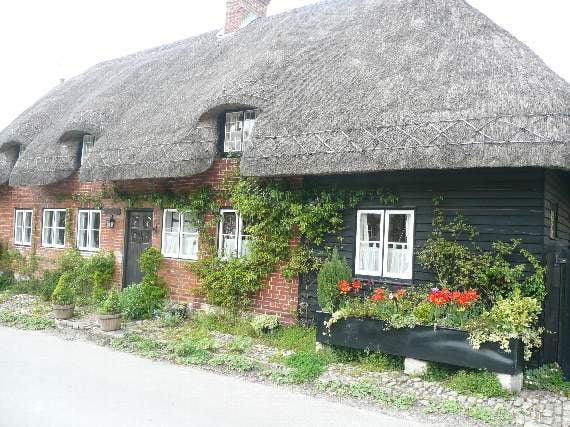
TODAY visitors to Selborne are treated to the breathtakingly pretty sights of at least seven Tudor cottages in the High Street and Gracious Street.
But although they fit today’s image of a rural-village idyll, there was nothing perfectly peaceful about the period in which these cottages were created - the Tudor period which spanned 118 years from 1485 to 1603.
And Selborne historian Edward Yates, in Knights, Priests and Peasants: A History of Selborne (Selborne Publishing, 2009) describes the vagrancy, violence, quarrels, religious turmoil and plague that were part of village life.
By the mid 1500s the leading gentry family in Selborne parish - incorporating the villages of Selborne, Blackmoor, Greatham and Oakhanger - was the Nortons, who lived outside the parish at Rotherfield Park, in East Tisted. They were the source of local power over a populace that was largely poor, according to Yates.



Forming part of Selborne’s “submerged population”, along with the paupers, would have been the destitute, the vagrants, says Yates. They lived “at the base of society”, beneath the gentry, the farmers (yeomen and substantial husbandmen), the cottagers and the labourers.
“After the closure of the monasteries no charitable institutions were present and the state turned to the parish,” says the historian. “Before the end of the 16th century, the parish had the task of policing, ale-testing, removal of stray dogs, eradication of pests, road maintenance and, most important of all, the care of the poor.
“The proclamations began in 1487 (under Henry VII), with the order that no one travelling was to be armed in any town or city, and no vagabonds were to be allowed to stay in any town or city,” says Yates.
“In 1493 it was ordered that all villages were to search for vagabonds. Those discovered were to be set in the stocks for three days, and given only bread and water. Anyone taking pity and providing them with food should be set in the stocks alongside the vagabonds.”
It is thought there was a pillory and whipping post at The Plestor in Selborne.
“Vagabonds unable to work were to be returned to the hundred (area) of their birth,” the historian says. “In 1530 (under Henry VIII) it was proclaimed that any vagabond found out of the hundred in which they were born, or where they had lived for three years, was to be stripped to the waist and whipped before returning to the relevant hundred.
“This was followed, in 1545, by the instruction that vagabonds were to be sent to the galleys. Two years later, branding and sale as slaves was the suggested remedy.”
Under Elizabeth I (who ruled from 1533 to 1603), overseers of the poor were established.
But, says Yates: “It was their duty not only to assist the deserving poor, but to ensure the whipping and branding of those thought to be undeserving. No private alms were to be given, but from 1572 the Poor Rate (a tax to finance the relief of the poor) was levied.
“It is to be assumed that these various orders were put into effect in Selborne.”
Vagrancy in Tudor England was caused, at least in part, by rural folk losing access to the strips of land they had been able to cultivate, as open fields were enclosed and as subsistence agriculture was replaced by capitalistic production for market.
“The more enlightened Tudor administrators saw the causal relationship between engrossment and dispossession on the one hand and the growth in the number of vagabonds on the other,” says Yates.
In Tudor Selborne parish sheep farming was widespread and wool was the major cash crop, says Yates.
Misery over enclosures, a drop in the value of wages (due to inflation) and the loss of the old pre-Reformation faith led to 1,000 rioters taking out their fury on gentry across Hampshire and Sussex in 1549 (when Edward VI was on the throne).
“In Selborne district it was Sir John Norton who suffered,” says Yates. “His house was pillaged and his barn burnt.
“The rebels captured included two local men, Michael Somer and Thomas Peacock, presumably poorer members of these well-to-do families.
“The two men were arraigned before a special assize at Winchester, presided over by the Lord Chief Justice, with (from the gentry) George Paulet of Norton, Sir John Norton himself and George Rithe of Hartley Mauditt.”
The Paulet family were tenants of the Norton family (who lived in East Tisted) at Norton manor.
With “bad blood” between the Rithes and the Nortons, George Rithe described John Norton as “a cruel man and an oppressor of poverty”, while Rithe was accused of helping the rebels and of being lenient when they appeared before him. This accusation was not proven but, says Yates, it is presumed that Somer and Peacock were hanged.
A gallows was thought to have existed at Galley Hill in Selborne.
The year after the uprising, in 1550, the breaking of enclosures by a group of 12 or more people became a felony punishable by death.
There was another planned uprising in 1586 (when Elizabeth I was on the throne) mainly in Hampshire - The Beacon Plot.
Believing that high corn prices were being caused by a dearth of corn caused by less land being used to grow it (because more was being used for cash crops), “the idea for the rising appears to have been initiated by William Mitchell, a tailor, and Zachary Mannsel, a weaver, both of Hartley Mauditt”, writes Yates.
“In time they were joined by other men,” writes the historian. “These included Richard Passenger, a fencer of Selborne; William Musgrove, a tailor of Selborne; and Robert Wolfe, a mason of Farringdon.
“The intention was to eradicate woad sowings, rob various rich men and destroy Sir Richard Norton’s house (the son of the Sir Richard targeted in the 1549 riot).”
The signal for the rising was to have been the firing of the signal beacons on local hilltops - the normal method of raising the country in the face of foreign invasion - which was probably Noar Hill in Selborne parish, says Yates.
The plotters, aware they needed a member of the gentry as a leader, tried to find such a person through their servant relationships. Mannsel and Mitchell went to Norton Farm, where George Rithe was living and tried to recruit a member of his staff.
But, according to Yates: “The security of the plotters was poor and the plot discovered before the beacons were fired.”
Once it was established that the motivation for the plot was the price of corn and not an attempt to return England to Rome, says Yates, most of the plotters were released.
“Fear of a Catholic uprising was a major concern of the government in view of the Spanish threat,” says Yates.
The Spanish Armada was ti sail, and fail, in 1588.
There must have been some fears among villagers when in 1587, with the threat of a Spanish invasion, the Selborne area mustered five men with body armour, two archers and 103 pikemen, of whom 41 were unfit for service. Led by Sir Richard Norton, the men marched to Ramsdean to be inspected.
“It is impossible to be anything but thankful that the Armada did not succeed in transporting the Duke of Parma, Spain’s military commander, to England,” says Yates.
In 1545 (under Henry VIII) John Norton had led 100 men from Selborne and Alton to Portsmouth to await any landing by the French.
These men were not subject to foreign service, for which “pressed men” were taken if volunteers proved insufficient.
In 1559, for the Dutch wars (of Elizabeth I), a Henry Carman of Selborne was among a group of pressed men delivered to Captain Wingfield at Portsmouth.
In 1600 there was another riot in Selborne, right at the end of the Tudor era (Elizabeth I was to die in 1603).
A complex dispute over lands in Oakhanger - held by Thomas Seaman but forcibly occupied by two tenants of Henry Campion - led to a 60-strong group gathering in Selborne and marching down Honey Lane to Oakhanger.
Led by four gentlemen - George Rithe, Francis Clement, George Morton and Walter Hayward - the group threatened the two tenants that unless they came out, they would be burnt out.
“The beans growing on the plot were cut down and thrown to the pigs,” says Yates.
Two men, Henry Pasker and Thomas Figge, who tried to help the tenants, were put in the stocks by the Selborne constable Lawrence Seaman and parish clerk Thomas Cobbe.
At a hearing, the constable said he had put the two men in the stocks “because of their behaviour in the Selborne alehouse”, says Yates.
“The landlady of the alehouse complained that they were behaving ‘in a very disordered manner’,” writes the historian. “He arrested them and left them in the stocks for six hours.”
The dispute is evidence of the pressure on land, according to Yates.
“Selborne should be as famous for its riots as it is for its association with Gilbert White,” the historian adds.
“Whether rioting was more prevalent in Selborne than in other villages it is difficult to say, although perhaps the absence of a resident gentry family (in the village) led to more freedom of expression than would otherwise have been the case.”
Although they were interrelated through marriages, the gentry families in the area were also “constantly at loggerheads, often coming to blows”, according to Yates.
The 1558 probate of country gentleman John Paulet, who lived at Norton, is revealing.
“The impression given by the inventory is of a large household, enjoying very solid comforts with no, or scarcely any, refinement,” writes Yates.
“There was nothing in the house of any great value save a silver salt and six silver spoons worth £5. There were no books, not even a Bible, but much weaponry. The times were violent.”
In fact there was even a murderer in the Norton family.
Robert Norton had broken into the Newton Valence house of Robert Smythe in 1558 or 1559, killing Smythe and stealing £160. Robert had employed another man to kill the victim’s mastiff guard dog a few days before. Robert fled but was captured and sent for trial at Winchester. But his brother, Sir Richard Norton, “by a mixture of bribes and threats” of witnesses and the jury, “ensured there was no case to answer”, according to Yates.
Some 30 years later, in 1589, Robert attempted to murder the rector of Farringdon’s church, John Griffiths.
“Robert, with an Irish soldier, hid outside Farringdon church, armed with a handgun and a dagger, to ambush Griffiths after evensong.”
Griffiths ran, although he was hit in the back by the thrown dagger.
At a lower level in the social scale, Richard Anstey, who worked land in Oakhanger, and Henry Hooker “quarrelled violently”, over a tithe of oats, says Yates. “Hooker called Anstey ‘a whoremonger, vagabond and rogue’.”
News of the quarrel spread to the Selborne alehouse.
Hooker alleged that Anstey had “brought a whore into the parish”, says Yates.
During the row, some suggestion emerged of a bawdy house (a brothel) in Hartley Mauditt and in Oakhanger, and that the keeper of the brothel’s wife was the whore.
Another upset in the lives of village folk in the parish was the English Reformation of the 16th century - the establishment of the Anglican Church.
Despite the break with Rome, the English Church remained generally Catholic for Henry VIII’s reign, says Yates.
But rapid change took place during Edward VI’s reign - a new Prayer Book was introduced; candles at Candlemas and ashes on Ash Wednesday were forbidden as superstitious nonsense; stone altar tables were destroyed; clerical marriage was approved, and the term “mass” disappeared, among other changes.
But in 1553 Mary I came to the throne and Catholicism was restored, before Protestantism returned with Elizabeth I’s accession in 1558.
When Stephen Gardiner, Bishop of Winchester, who opposed Protestantism, was taken to Winchester to be buried after his death in 1555, the cortege, as it wound through the countryside, called at various villages en route, including Selborne and Newton Valence.
Yates says: “The majority of people, generally indifferent, were prepared to conform with whatever beliefs were held by the Crown to be correct - the difficulty was in establishing just what was held to be correct at a given moment.”
And then there was disease to deal with and, it is believed, plague struck Greatham in 1580 and 1597, Petersfield in 1563 and Selborne in 1575.
“The bishop’s visitation books report that in 1575 there was so much plague in Selborne that no churchwardens were appointed,” says Yates.
“Deaths in (the village) that year were 17, with the comment in the register that eight were from plague. A total 17 deaths were recorded the following year, whereas the average for the decade 1563-1572 had been fewer than eight. Perhaps, the saddest report of all attaches to the 1570 will of Elizabeth Usman, noting as she lay dying of the pestilence no one should go near her for fear of contracting the disease.”
It was a hard life 500 years ago among today’s pretty cottages.
Comments
This article has no comments yet. Be the first to leave a comment.