
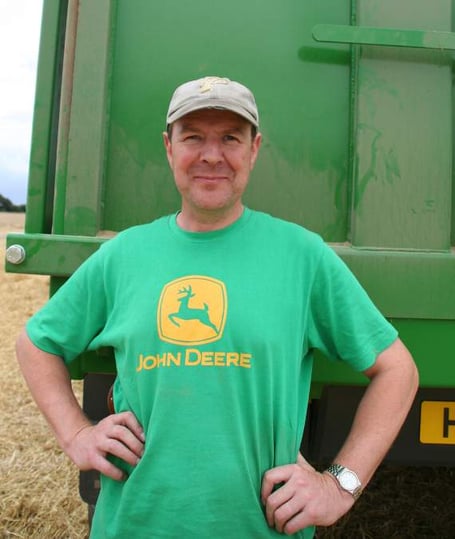
AS the NFU prepares to launch farming’s most significant consultation for a generation following the UK’s decision to leave the EU, a district farmer has joined NFU president Meurig Raymond in urging the Government not to ignore the economic importance of the farming sector.
Julian Gibbons, an arable farmer from Bradley, near Alton, who with brother Andy farms land at Lower Wield, the Candover Valley and Nether Wallop, is Hampshire’s delegate on the NFU Council.
And he was in London last Friday for an extraordinary meeting of the council to discuss the impact of Brexit on the agricultural industry and what a domestic farming policy should look like outside the EU.
The key concern is that uncertainty is not good for farmers and that a policy needs to be in place by September at the latest, said Mr Gibbons.
-Cllr-Lulu-Bowerman-Tim-Lawton--Image-LDRs.jpeg?width=209&height=140&crop=209:145,smart&quality=75)



In describing agriculture as “the bedrock of the UK’s largest manufacturing industry, food and drink, which is worth £108bn and employs 3.9 million people”, Mr Raymond said after Friday’s meeting that the council had agreed “the principles of a domestic farming policy which will now form the basis of the biggest farming consultation in England and Wales for a generation”.
And he added: “Currently there are lots of uncertainties for farming – trade agreements, labour, financial support, legislation are all up in the air – but the NFU is committed to providing this industry with leadership.
“The NFU will consult its members, in every sector, in every county, to ensure that its members have a say in shaping the future of farming for them, their children and their grandchildren and for Britain’s children and grandchildren. I urge all NFU members to get involved in this consultation over the coming months and that non-members should join the NFU to ensure their voice is heard. With this consultation, we can be sure that the policy we push for will have the backing of the farming sector at large.
“The contribution of this country’s farming and food industry to the economy and to food security should be taken extremely seriously by the UK government. We need a policy that ensures a profitable, productive and sustainable future for British farming. The NFU’s influence, with the backing of its membership, is paramount in this.”
They are sentiments shared by Mr Gibbons who, while disappointed at the results of the EU referendum, said: “We are where we are and there is no point in looking back, we just have to get on and make the best of what we have.”
Mr Gibbons said that Hampshire farmers were particularly concerned with access to seasonal labour, that access to the EU and global marketplace should continue, that future support schemes should be more simple and easier to manage, and that UK farmers should be able to compete on a level playing field with imported produce and not be penalised for adhering to higher but more expensive welfare standards.
In the Alton area, where many farmers are involved in fruit growing and vineyards, seasonal labour is key and the fear is that withdrawal from the EU will cut off a vital source of migrant labour. While the NFU is calling for the setting up of a possible student scheme, the times when casual labour is needed, for pruning and fruit picking, are the times when UK students are not available. Furthermore, the culture in the UK is such that many people seem unwilling to put in the long hours and most want regular full or part-time jobs. But, says Mr Gibbons, seasonal labour is a good way for students to earn money because it is full on and the money accumulates because there is no time to spend it.
There is concern also from broad-acre crop farmers, many growing malt and barley which, in the past, has gone on lorries to Southampton to be shipped onto the Continent.
“We want as good an access to these markets as we have now,” he said.
He further points out that, due to higher welfare standards, the UK is an expensive food producing nation, so it is vital to the industry that the Government does not allow unfettered access to home markets from overseas producers who have lower welfare standards and costs.
He gave as an example the pig industry where, due to public pressure, the UK unilaterally brought in higher welfare standards 20 years ahead of the EU which pushed up the price of home-reared pig meat, making it uncompetitive and resulting in the loss of 60 per cent of the UK pig industry.
On the question of financial support, Mr Gibbons said that while farmers were constantly receiving support from the EU the application system was complicated, being designed to cover all 28 countries, and the penalties harsh if you made a mistake.
This, he said, was an opportunity to design a scheme for the UK which would be simple to run, easy to administer and, importantly, one that can be seen by the tax payer to be run properly and not abused.
Likewise with environmental schemes. While the UK has seen great benefits via the EU schemes they were, said Mr Gibbons, becoming too complicated and fraught with worry - “if you don’t get it right the fines are high”.
His key message was that uncertainty is worrying for the industry. Having worked for the past 42 years to a common EU agricultural policy, there is an urgent need for the NFU to formulate an idea of what the industry would like a UK agricultural policy to look like before it has to negotiate with the new Secretary of State for the Department for Environment, Food and Rural Affairs.
The hope is that an option paper will be approved by the end of July, with consultation throughout August and September.
He added: “What we don’t want is a protracted consultation. Farmers don’t like uncertainty, it’s harder to plan and invest in business. We have to get on and plan for the future.”
Comments
This article has no comments yet. Be the first to leave a comment.