
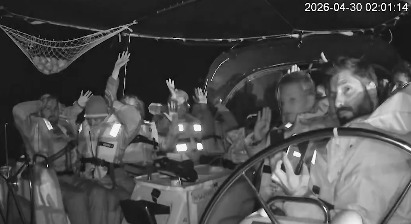
A Hampshire Green Party candidate has described how he and fellow activists “thought they might die” after Israeli naval forces intercepted a Gaza-bound aid flotilla in international waters.
Zak Khan, a Green Party candidate for the Blackwater Valley division in the Hampshire county council elections, says he feared for his life after Israeli naval forces intercepted the Global Sumud Flotilla (GSF), a humanitarian aid convoy carrying medical supplies towards Gaza.

Mr Khan was among around 175 activists aboard the flotilla, made up of 22 boats, intercepted on April 30 in international waters near Crete, hundreds of nautical miles from Gaza.

-and-the-Kwik-Fit-team.jpeg?width=209&height=140&crop=209:145,smart&quality=75)
Also on board was Brazilian activist Thiago Ávila, who was recently released after 10 days in Israeli detention.
Mr Khan, who had been standing watch on deck after reports that Israeli naval forces could intercept the flotilla, had briefly stepped inside to collect a dinner plate when armed personnel surrounded the vessel.
In an interview, he recalled the moment Israeli forces boarded the ship.
“Suddenly the windows lit up with laser sights from assault rifles. Before I could even react, we heard shouting over a loudspeaker, ‘Israeli Navy. Everyone inside. Hands up.’”
What followed, according to Mr Khan, was hours of fear, detention and violence that transformed the humanitarian mission into a terrifying confrontation at sea.
The flotilla had set sail carrying humanitarian supplies intended for Gaza. On board were surgical gowns, antibiotics, anaesthetics and emergency medical equipment, enough, he claimed, to support dozens of surgeries.
Instead, he says, Israeli forces stormed the vessel, cut the live-stream cameras broadcasting the mission and detained everyone aboard at gunpoint.
As armed personnel boarded the ship, Mr Khan rushed to distribute life jackets to passengers.
“I started throwing them to people because nobody knew what was about to happen. I thought people could be injured, thrown overboard, anything.”
Passengers obeyed orders and were forced into the cabin before being brought outside one by one under the barrels of assault rifles fitted with laser sights.
“They shouted: ‘Move slowly. Keep your hands above your head. Don’t reach into your pockets.’”
Outside on the deck, passengers were allegedly stripped of outer clothing and searched in the freezing night air.
“The Mediterranean at night was absolutely freezing. Some people were left in just T-shirts. Others were left in bras. People were shaking uncontrollably.”
He said the humiliation was almost as overwhelming as the fear itself.
“They took our clothes, our shoes, our medication. Then they sat us down while soldiers kept guns trained on us.”
According to Mr Khan, detainees were later transferred onto a larger Israeli naval vessel converted into what he described as a floating prison made from shipping containers.
Activists were zip-tied, assigned prisoner numbers and held in overcrowded conditions where many were forced to sleep directly on metal floors or outside, exposed to the elements.
“There were about 180 of us. But the containers only had space for maybe 140. The rest slept outside.”
At night, he alleged, guards flooded the ground where detainees attempted to sleep.
“People were soaking wet in the cold. Then during the day we’d be left in the blazing heat with almost no water.”
Food rations reportedly consisted mainly of bread and small portions of cheese shared among multiple detainees.
Some activists launched a hunger strike in protest, while others organised makeshift survival teams responsible for sanitation, shelter and night watches.
Using thin rubber sleeping mats, detainees attempted to build protection from the wind and rain.
As dawn broke during his first morning in detention, fellow activists discovered it was Mr Khan’s birthday.
Inside the prison ship, surrounded by armed guards, detainees began singing to him.
“It was one of the strangest moments of my life. Hearing people sing ‘Happy Birthday’ while we were being held prisoner in the middle of the sea.”
According to Mr Khan, Israeli personnel conducted “counts” every few hours, forcing detainees to stand, kneel or squeeze into overcrowded containers regardless of the weather or time of day.
“It was sleep deprivation. That was the point.”
Tensions escalated when detainees refused to comply with instructions until separated activists were returned and confiscated medication restored.
During the protest, Mr Khan alleges Israeli personnel responded with violence.
“They started taking people one by one. Beating them in front of everyone.”
Among those allegedly targeted were Thiago Ávila and Spanish-Palestinian organiser Saif Abu Kashak.
Mr Khan spoke emotionally about Ávila, describing how activists had formed close bonds during weeks together at sea.
“We cooked together. We stood night watch together. We’d sit drinking tea talking about his daughter and the world he wanted her to grow up in.”
As detainees realised they were being transported towards Israeli custody, Mr Khan said fear spread rapidly throughout the ship.
“We were terrified. I feared for my life 100%. We thought we might die.
“We knew what people had faced in Israeli prisons. We knew the stories. We knew what could happen to us.”
According to Mr Khan, Israeli personnel explicitly warned that conditions inside Israeli prisons would be significantly worse than what they were already experiencing.
“They told us if we were taken to Israel, we would be treated far worse there. And this was after we had already been beaten, deprived of sleep, stripped and held at gunpoint.”
On the day of his release, Mr Khan says he was beaten after refusing to leave the ship without confirmation that missing activists were safe. He alleged four Israeli personnel assaulted him.
“My jaw was nearly broken. I was shot in the leg with a non-lethal round.”
Afterwards, Mr Khan said his hands were zip-tied behind his back while his head was forced downward as he was dragged across the vessel.
“They kept smashing my head into things while moving me. I couldn’t even see where I was going.”
Eventually, detainees were transferred to Greek authorities in Crete, where local residents offered food, shelter and medical assistance.
Mr Khan said 34 activists required hospital treatment after their release, including three transferred into critical care because of the severity of their injuries.
In Crete, members of the local community helped activists recover. Mr Khan said he was hosted by a physics lecturer from a local university who provided him with food, clothing and accommodation.
Despite the interception and the alleged beatings, Mr Khan insists he does not regret joining the flotilla.
“I would do it again. It was about refusing to stay silent while civilians are suffering. If governments won’t act, ordinary people feel they have to.”
In a statement on April 30, the Israeli foreign ministry, Misrad HaHutz, said that due to the large numbers of vessels participating in the flotilla and “the risk of escalation, and the need to prevent the breach of a lawful blockade, an early action was required”.
It added: “The operation was carried out in international waters peacefully and without any casualties. An initial inspection of the vessels revealed materials that appear to be drugs and contraceptives.”
The same day, Israel’s ambassador to the United Nations, Danny Danon, said in a post on social media that the flotilla was “stopped before reaching our area” and Israeli soldiers were acting with “determination dealing with a group of delusional attention-seeking agitators”.
Israeli Prime Minister Benjamin Netanyahu congratulated the Israeli Navy, saying the mission to keep the flotilla away had been a success.
“They will continue to watch Gaza on YouTube,” he said.
Comments
This article has no comments yet. Be the first to leave a comment.