
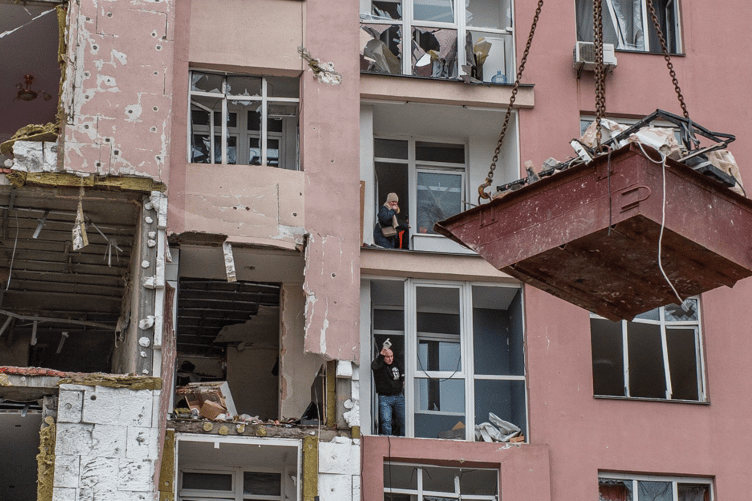
I arrived in Kyiv and have been staying here for some time. The war is immediately recognisable.
The first night was very dark. Russia carried out multiple drone attacks. By morning, there was no electricity. We cooked on a camping stove and later went to eat in a café. The noise of generators is everywhere — the streets are buzzing all the time.
Generators bring another cost. Their constant noise, the smell of fuel and emissions into the air have become part of the city’s background. This is another price of war that is rarely spoken about.
In a shop, I overheard two women talking: “At home, it is cold. It is dark. I cannot even turn on a heater. I come to work as if it were a celebration — at least the generator is running here.”



Cafés have become places to work, to warm up and to talk — small islands of light during long power cuts.
Together with British journalist Felicity Spector, I visited the Good Bread Bakery — a place that continues to operate despite power cuts and air-raid alerts. They bake bread for the front line. Inside, there was warmth and the smell of fresh bread. It felt like a quiet form of resistance: ordinary work carried on under extraordinary conditions.
Russian missile attacks are deliberately aimed at cutting power ahead of the winter cold. In many regions, electricity is unavailable for 14 to 16 hours a day. In Odesa and Kryvyi Rih, this is no longer a forecast but a reality: power has disappeared there for days at a time.
These days, the temperature in Kyiv is –10°C (14F). The city is white and quiet. It feels as if the snow is trying to cover the darkness and the ruins left behind by the attacks.
I met my colleague, photojournalist Oleg Pereverzev. After Russia’s full-scale invasion, he joined the army. He lost his left leg in the war.
Suddenly, Oleg screamed — phantom pain. The limb he lost still hurts. Over time, the injured leg shrinks, and the prosthesis needs constant adjustment.
“Because of the power cuts, the lifts don’t work,” he said. “Climbing to the 13th floor every time is very hard.”
Things once done automatically now turn into daily trials. Small, ordinary actions become exhausting.
At one point, I felt close to breaking. When everything becomes difficult — heat, light, rest — plans collapse, and life itself feels fragile.
In Kyiv, the sense of safety disappears. There is no truly safe place. Some parents put their children to sleep in bathtubs, corridors, wardrobes or underground. An air-raid siren can catch you anywhere — in a hospital, at a petrol station, in a shop, a café or at home.
One night, sleep was almost impossible. Air-raid sirens, the hum of air-defence systems and explosions from missiles and drones lasted until morning. The targets were residential areas and energy infrastructure. I moved around Kyiv photographing the aftermath.
The war in Ukraine has long ceased to be confined to the front line — it lives in the city every day.
Natalia Sharomova is a Farnham-based Ukrainian photojournalist.
Comments
We've recently changed our login process. If you have an account for commenting, you will need to re-register on the login window.
This article has no comments yet. Be the first to leave a comment.